REVIEW · LONDON
East End London Instagrammable Street Art and Graffiti Tour
Book on Viator →Operated by Tours by Foot London · Bookable on Viator
Street art in London hits different. This East End tour maps the walls, doors, and backyards of Shoreditch for photo-ready graffiti, from big murals to tiny stickers, with a focus on the stories behind the paint. You’ll get guided stops built for looking up, stepping closer, and getting angles that actually make your photos work.
I love the way the walk teaches you how street art works as a conversation, including the past graffiti wars and why pieces get defaced, repainted, and remembered. I also like the fact that it includes time to make your own street art, not just take pictures.
One thing to consider: it’s about 2 hours of walking, and several stops involve turning into small yards or tight corners where you’ll pause for viewing and photos. Wear good shoes and plan to move at a steady pace.
In This Review
- Key reasons this East End graffiti tour is worth your time
- East End street art in 2 hours: what you’re really signing up for
- Price and value: is $49 fair for street art + hands-on time?
- How to see graffiti like a pro (before you chase the next mural)
- Heneage Street and Brick Lane: murals in unexpected places
- Stop 1: Heneage Street’s Phlegm creatures and FanakaPan’s balloon twist
- Stop 2: Brick Lane door art by Dan Kitchener and Perspicere
- The Seven Stars, Princelet Street, and Hanbury Street: stickers, resilience, and old-school scale
- Stop 3: The Seven Stars and sticker-only storytelling
- Stop 4: Princelet Street and Stik’s community message
- Stop 5: Hanbury Street bird by ROA and the upside-down man by Martin Ron
- Dray Walk and Broccoli Lane: a strange tradition that actually makes sense
- Stop 6: Rainbow broccoli on Dray Walk
- Allen’s Gardens and Buxton Street: graffiti parks and collaborations
- Stop 7: Allen’s Gardens and letter-only works you can’t quite decode
- Stop 8: Buxton Street and looking for collaborations
- Ebor Street switches gears: Neon portraits to Ben Eine big letters
- Stops 9 and 10: Ebor Street’s mix of painted ads and readable lettering
- Rivington Street: Banksy’s glass-panel presence and the art-market debate
- Stop 11: A secret place for Banksy (and a discussion prompt)
- Stop 12: Otto Schade’s ribbons and stencil energy
- Stop 13: Thierry Noir’s bright heads and street cheer
- Stop 14: art’otel London Hoxton and a Banksy wall set back into public view
- Curtain Theatre bench to New Inn Broadway: graffiti where culture meets the wall
- Stop 15: Shakespeare at the Curtain Theatre grounds
- Stop 16: New Inn Broadway and one building covered wall-to-wall
- Ending on Shoreditch High Street: the last graffiti wars story
- Practical tips to make your photos and viewing smoother
- Should you book this East End London graffiti tour?
- FAQ
- How long is the East End London Instagrammable Street Art and Graffiti Tour?
- How much does the tour cost?
- Where do I meet the guide and where does the tour end?
- Is the tour guided?
- Do I get to make street art during the tour?
- Is there free cancellation?
Key reasons this East End graffiti tour is worth your time
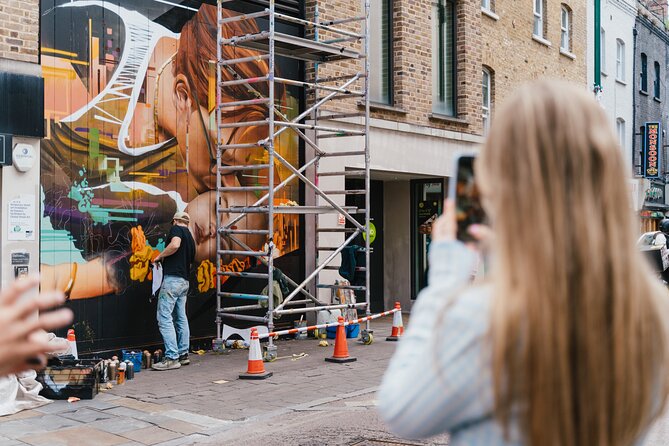
- Instagrammable photo angles on purpose: the guide starts from distances, then moves you in close when the art gets detailed
- Big-name street artists appear in real places: Banksy is a highlight, alongside ROA, Ben Eine, Stik, and Thierry Noir
- Hidden-yard stops that feel like street-level discoveries: backyards, narrow spaces, and sticker-heavy walls
- Graffiti park time where the art changes fast: Allen’s Gardens pieces can update every few days
- Hands-on creativity: you get the chance to make your own street art during the tour
East End street art in 2 hours: what you’re really signing up for
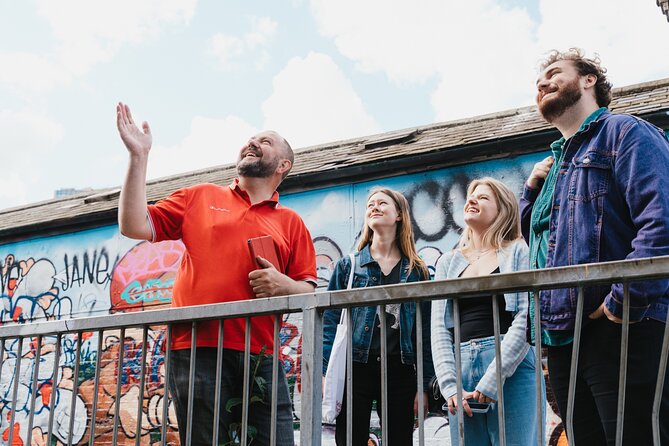
This is a guided East End London street art and graffiti walking tour focused on what makes Shoreditch feel current: murals that cover whole walls, door-sized works that reward stepping closer, and stickers that look like they were dropped by someone with a sense of timing.
The tour runs about 2 hours and keeps the group small (up to 20). That matters more than it sounds. With street art, you’re often stopping at spots where space is tight. A smaller group helps you actually see the art instead of hovering behind other people.
You also don’t have to guess how to start. The tour meets at 80 Whitechapel High St, London E1 7QX, begins at 11:00 am, and finishes near Liverpool Street Station (the exact end can shift depending on what’s on display that day).
You can also read our reviews of more tours and experiences in London

Price and value: is $49 fair for street art + hands-on time?
At $49 per person, this is priced like an activity, not like a museum ticket. The value comes from two things you can’t easily DIY without local help:
1) A guided route with specific viewing instructions
You’re not just walking past walls. The stops are built around how to look—like starting from a distance first, then moving forward when the artwork reveals details.
2) Included time to create street art
That hands-on part is the difference between a photo walk and a real experience. Even if you’ve never made street art before, the tour gives you a chance to try, while you’re surrounded by examples of different styles.
Also, the individual stops are set up so you don’t pay entrance fees at each location (admission listed as free at the stops). So your main cost is the guide + the structure.
If you’re the type who enjoys art that changes—sometimes quickly—you’ll probably feel like this pays off.
How to see graffiti like a pro (before you chase the next mural)
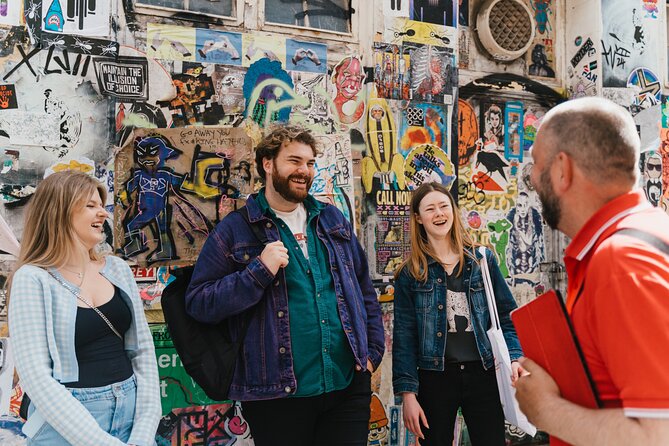
Street art can feel random if you’re only looking at it head-on from the sidewalk. This tour nudges you into a better way of seeing:
- Look up first: a lot of the most interesting work is higher than you think.
- Use angles: some pieces are door-sized or built into building features, so the best view isn’t the first view.
- Track the style clues: stickers, stencils, script/lettering, and big-character mural work each “read” differently.
- Expect change: some walls update every few days, and others get defaced, then repainted.
That mindset helps you enjoy every stop, even when you’re not sure what you’re looking at at first.
Heneage Street and Brick Lane: murals in unexpected places
The tour starts with a classic East End setup: places that feel tucked away, but turn into real canvases once you’re standing in the right spot.
Stop 1: Heneage Street’s Phlegm creatures and FanakaPan’s balloon twist
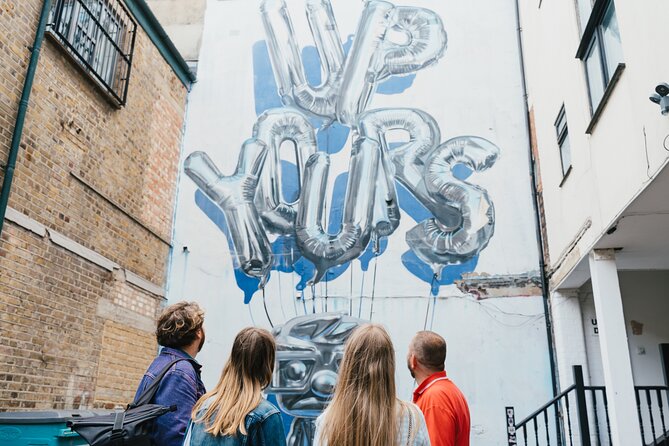
At Heneage Street, you’ll find huge pieces tucked behind small backyards. One work features Phlegm, with his signature long, slim creatures that seem to walk on stilts—above tags of other artists who can’t help but look smaller in comparison. Across the street, even more tucked away, you’ll see work attributed to FanakaPan, known for silver, helium-balloon imagery. The fun here is in the details: take your time looking up because the art rewards it.
Why it’s great for you: it’s a strong “wow” start, and it teaches you to look for scale and layering—how different artists occupy the same city space in different ways.






Stop 2: Brick Lane door art by Dan Kitchener and Perspicere
Then you shift to Brick Lane, where viewing often means changing your distance. Some works are on doors, so they aren’t huge in footprint. The trick is that you can’t appreciate them without stepping into the right spot.
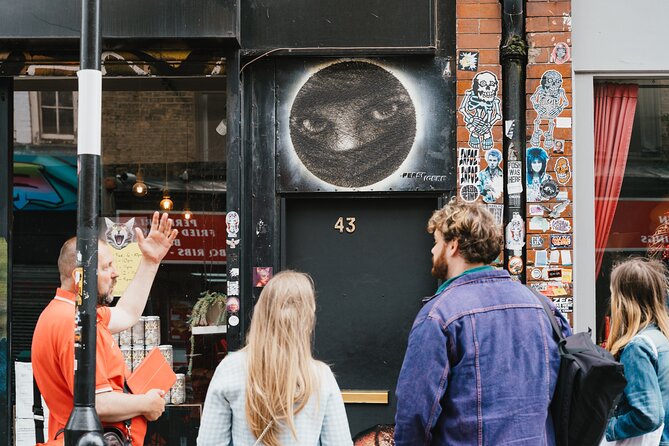
This stop begins from a distance to look at works by Dan Kitchener and Perspicere, then closes in so you can notice technical skill and finer details. It’s a good reminder that street art isn’t only big walls. Sometimes it’s a perfectly placed piece on something small that forces you to come closer.
Possible drawback: door art and smaller formats can be harder to photograph if there are crowds or if you’re rushed. Go slow and let the guide’s positioning do the work for you.
The Seven Stars, Princelet Street, and Hanbury Street: stickers, resilience, and old-school scale
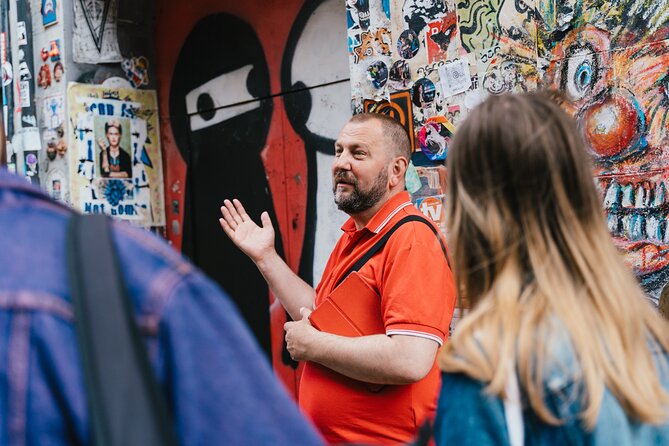
East End graffiti isn’t one style. It’s a mix of mediums and moods, from stickers to solemn community pieces.
Stop 3: The Seven Stars and sticker-only storytelling
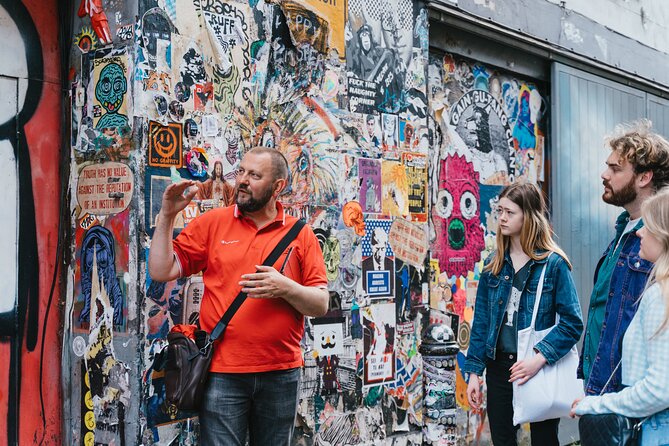
A narrow yard can feel intimidating at first, but this is where stickers take over. Here, stickers aren’t “extras.” They’re the main language. The concept of becoming the eighth star (by leaving a small mark of your own during the hands-on element at this point in the tour) keeps the energy playful and participatory.
Stop 4: Princelet Street and Stik’s community message
On Princelet Street, you’ll see art that’s meant for the local community, shaped by the area’s long ties to refugees and immigrants. The piece attributed to Stik is dedicated to the Muslim community, and the story includes a practical reality of street art: it’s been defaced over time, then repainted again. That cycle of damage and restoration is part of the point.
This is one of those stops where you learn to see resilience as part of street art’s meaning—not just the original image.
Stop 5: Hanbury Street bird by ROA and the upside-down man by Martin Ron
Then you hit Hanbury Street, where one big bird leads you into a deeper visual maze. At first glance you’ll juggle multiple types of graffiti: stickers, black-and-white slogans by Wrdsmth, and smaller colorful pieces that can change often.
The two major older works are the bird by ROA and the upside-down man by Martin Ron, both described as being there for ages—around 20 years. That’s “ancient” in graffiti terms. The upside-down man is the kind of piece you’ll want to study for skill, especially because it seems to incorporate features of the building rather than simply overwrite them.
Photo tip: zooming in can help, but your best shot may still require stepping back to capture the whole illusion on the wall.
Dray Walk and Broccoli Lane: a strange tradition that actually makes sense
Not all street art is serious. Some of it is just… weird, and that’s why it sticks.
Stop 6: Rainbow broccoli on Dray Walk
Dray Walk is where the broccoli phenomenon becomes physical. You’ll see broccoli pieces that range from realistic to rainbow-colored. Here, one is attached to the wall, and the story goes back years. It even influenced the street name—parts of the area have been linked to Broccoli Lane.
The artist tied to starting the trend is Adrian Boswell, who now has a gallery and sells broccoli-themed works, including broccoli in frames. The practical takeaway: street art can become a recognizable brand, even when it begins as playful public tagging.
Allen’s Gardens and Buxton Street: graffiti parks and collaborations
If you want to understand street art lettering and how writers communicate without traditional “readability,” this is where it gets interesting.
Stop 7: Allen’s Gardens and letter-only works you can’t quite decode
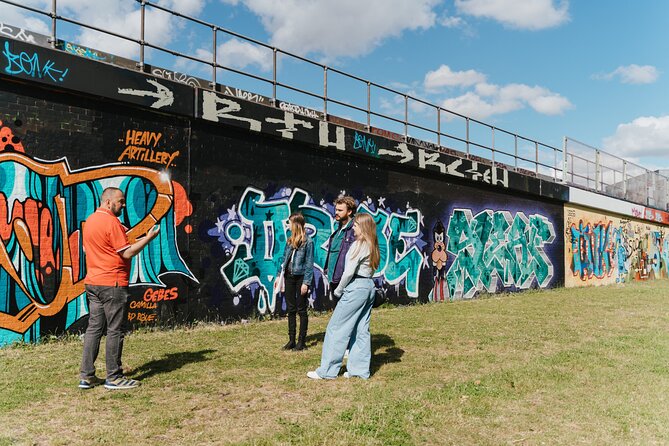
Allen’s Gardens is a graffiti park ringed by walls full of work. Some pieces change frequently—every few days is mentioned—so timing matters. This is the stop where you should treat photos like an important job: take them while the art is still exposed.
A key detail here is what kind of graffiti dominates. Most of it comes from letter writers—artists who focus on letters. The challenge is that the letters can be almost impossible to read. It’s not the message that matters first. It’s color, style, and technique. If you like street art for its visual rhythm rather than its literal meaning, you’ll likely love this.
Stop 8: Buxton Street and looking for collaborations
After the park, you’ll be told to look up for number 5 on the wall—because it’s tied to a specific artist’s section. This is also where collaborations appear, meaning more than one artist contributes to the same wall. It’s a small stop, but it helps you understand how street art is often collaborative even when pieces look like they’re by one person.
Ebor Street switches gears: Neon portraits to Ben Eine big letters
East End street art can change from delicate to bold in the span of a single street.
Stops 9 and 10: Ebor Street’s mix of painted ads and readable lettering
On Ebor Street, you’ll see large-format adverts painted by graffiti artists, plus smaller pieces like pink portraits by Neon. The portraits are described like a gentle mist of spray paint, but falling exactly where the face needs to form—so the result looks controlled, not random.
Then the tour takes you to the opposite end of the style spectrum: Ben Eine. His work features big, bold letters that are easy to read from a distance. Even though the letter style is consistent, different fonts and shapes appear across his works—sometimes curving and elaborate, sometimes sharp and modern, sometimes square.
This pair of stops is smart for your brain. It forces you to notice how the same space can support two different “reading experiences”: one where you step close and decode details, and one where you step back and let the letters do the work.
Rivington Street: Banksy’s glass-panel presence and the art-market debate
Rivington Street is a cornerstone of this tour experience because it includes Banksy and because the tour invites you to think about how art is displayed and protected.
Stop 11: A secret place for Banksy (and a discussion prompt)
Not many Banksy works remain, but you’re taken to a secret spot where older Banksy pieces are seen alongside other, lesser-known but notable art. You’ll recognize the Banksy works because they’re covered with a glass panel.
This is where the tour makes space for your opinion. You’ll talk through whether the glass panel matters, if it changes the way you see street art, and how you feel about the art market, trends, and personal taste.
Stop 12: Otto Schade’s ribbons and stencil energy
Next you’ll spot half of a soldier, then understand you’re meant to view it from the corner to see the full composition. The artist here is Otto Schade, known for a look like ribbons. Even when the forms feel airy or empty inside, the pieces are described as full of energy, built from stencil work pushed into new style.
Why it matters: if you usually think of stencils as flat and graphic, this stop shows how stencil art can still feel dimensional and kinetic.
Stop 13: Thierry Noir’s bright heads and street cheer
Then it’s Thierry Noir, with colorful head portraits credited to a career spanning over 40 years. You’ll learn that he’s best known for work connected to the Berlin Wall in the 1980s, but he’s left a mark in London too.
The practical effect of this stop is mood. Bright faces on walls do what many street artists aim for: they make you look twice, even if you weren’t planning to.
Stop 14: art’otel London Hoxton and a Banksy wall set back into public view
This is where street art meets mainstream space. At art’otel London Hoxton, powered by Radisson Hotels, a Banksy piece is described as a wall segment painted long ago, taken away from its original location, then reinstated so people can see it.
Even if it’s inside a newer, artsy hotel context, it’s still presented outside on the street where anyone can admire it—and critique it.
This stop is useful because it forces a question: when does street art stop being “street” and start becoming “exhibit”? You get to think about that without needing a lecture.
Curtain Theatre bench to New Inn Broadway: graffiti where culture meets the wall
Not all East End street art ties back to modern fame. Some of it ties into London stories you already know.
Stop 15: Shakespeare at the Curtain Theatre grounds
On Hewett Street, you’ll suddenly see Shakespeare at the Curtain Theatre location—quietly sitting on a bench. The graffiti here includes a Romeo and Juliet piece, described as where people first heard the love story.
It’s a clever pairing: you walk through graffiti, then land at a place connected to theater history. The effect is that the street feels like it’s still writing new chapters.
Stop 16: New Inn Broadway and one building covered wall-to-wall
Then you see a larger building area painted over by many artists—a true graffiti wallpaper experience. Different color palettes and styles mix together, with even a small policeman element included in the combined artwork.
This stop is ideal if you like variety. You don’t have to commit to one style because the building does it for you.
Ending on Shoreditch High Street: the last graffiti wars story
The tour shifts toward the City side after the older, rougher Shoreditch feel. You’ll reach Shoreditch High Street and hear one last story about the Graffiti Wars—presented as serious in concept, but with real art as a result.
It’s a good closing structure. You start with towering murals, travel through hidden corners and community resilience, then finish with the “why” behind the whole scene.
Practical tips to make your photos and viewing smoother
You’ll enjoy this tour more if you come prepared to look carefully, not just snap quickly.
- Bring a camera/phone with decent low-light settings. Some yards and corners can feel dim compared to the street.
- Use the guide’s distance instructions. Starting far and then moving in is part of how the art is meant to be seen.
- Wear comfortable shoes. The pace is steady for about 2 hours, and a few stops happen in narrow spaces.
- Take your shots early at fast-changing walls. Allen’s Gardens is the place where you want to trust the timing.
If you’re a street art person, you’ll also appreciate how this route teaches you the styles—stickers, stencils, letter work, and mural storytelling—without turning it into a textbook.
Should you book this East End London graffiti tour?
Book it if you want a guided, photo-focused street art walk in Shoreditch that includes both famous names (including Banksy) and the less obvious styles that make the neighborhood feel alive. The $49 price makes more sense when you factor in the included chance to make your own street art and the guide’s positioning for shots and viewing.
Skip it (or choose a different kind of tour) if you want long, museum-style explanations or if you hate walking and tight corners. This tour’s strength is movement, viewing stops, and quick immersion into what’s on the wall today.
FAQ
How long is the East End London Instagrammable Street Art and Graffiti Tour?
It lasts about 2 hours.
How much does the tour cost?
The price is $49.00 per person.
Where do I meet the guide and where does the tour end?
You start at 80 Whitechapel High St, London E1 7QX, and you end within walking distance of Liverpool Street Station (the exact end point can change depending on the art).
Is the tour guided?
Yes. It’s a walking tour led by a local London guide, and it’s limited to a maximum of 20 travelers.
Do I get to make street art during the tour?
Yes. The tour includes an opportunity to make your own street art.
Is there free cancellation?
Yes, you can cancel for a full refund up to 24 hours before the experience’s start time, and free cancellation is available.