REVIEW · LONDON
Jack the Ripper in London: Quest Experience
Book on Viator →Operated by Questo · Bookable on Viator
Ten bells. One mystery trail.
This Jack the Ripper in London: Quest Experience turns the East End into a walk-and-find game, with short stop-by-stop challenges that focus on clues and stories tied to the case.
I like the offline mobile game setup, because you can keep moving without hunting for signal. I also like that the route mixes famous sites with very real neighborhood corners, so you get more than the usual “sightseeing script.”
The main drawback to consider: there’s no physical tour guide, so if you need lots of hand-holding, you may find the prompts or directions frustrating.
In This Review
- Key highlights at a glance
- Why this Jack the Ripper quest works better than a classic tour
- Price and time: what $7.21 gets you in real value
- Start-to-finish route: from Bishopsgate to Whitechapel Bell Foundry
- Fruit & Wool Exchange: start where imported produce changed the city
- Christ Church Spitalfields and Nicholas Hawksmoor’s commissioners’ church style
- The Ten Bells: a pub corner where stories get repeated
- 19 Princelet St: a small building with big migration-era connections
- The Old Truman Brewery: where East London turned storage into creative space
- Brick Lane Mosque (Jamme Masjid): layers of faith on one famous street
- Happy Days: a possible clue site and a piece of graffiti you can track
- Mitre Square at 1:45am: Catherine Eddowes’ death site
- The White Hart: the long-running pub thread in Whitechapel
- Henriques Street (Berner Street): the third-murder street angle
- What to expect from the Quest format (and why it can annoy some people)
- Should you book Jack the Ripper in London: Quest Experience?
Key highlights at a glance
- Offline play means you can run the game without an internet connection
- Self-paced route with about 10 minutes per stop, built for your schedule
- East End stops with recognisable landmarks like Christ Church Spitalfields and Brick Lane Jamme Masjid
- Challenge format: you’re looking around for answers instead of only listening
- Free entry at a few stops (notably 19 Princelet St, Mitre Square, and Henriques Street areas)
Why this Jack the Ripper quest works better than a classic tour
If you’ve ever been stuck on a guided walk where you’re forced to keep pace with strangers, this format feels different. You’re not tied to a guide’s voice or a fixed stop-time. You move through Spitalfields and Whitechapel with a game structure, and you decide how long to linger at what catches your eye.
I also like that the story approach is built around looking carefully. Several stops are framed as you searching around for the answer to a challenge. That turns “dark history tourism” into something active and hands-on, which is exactly what keeps the route from feeling like a lecture.
One more practical win: it’s offered in English, and it’s designed so most people can participate. If you enjoy puzzles, photo-spotting, or reading small details in public spaces, you’re in the right mindset.
You can also read our reviews of more tours and experiences in London.



Price and time: what $7.21 gets you in real value
This experience costs about $7.21 per person and runs roughly 2 hours. For that, you’re buying a self-guided walking story with a phone-based challenge format, not a traditional guided talk.
In value terms, the key is the combo of:
- a clear time block (about two hours)
- an offline game experience
- a route that strings together multiple notable East End locations
The price also stays friendly if you’re traveling on a budget but still want something themed that feels specific to London’s geography, not generic “London at night” vibes.
Start-to-finish route: from Bishopsgate to Whitechapel Bell Foundry
You begin at 178A Bishopsgate, London EC2M 4NQ, and the walk ends near the Whitechapel Bell Foundry, 34 Whitechapel Rd, London E1 1DY. That end point matters, because it places you right where the Jack the Ripper story has the strongest London identity.
Along the way, you’ll move through the East End’s layered mix of grand stone facades, working-street architecture, houses of worship, pubs, and today’s creative spaces. Even if you know the headline names, the route helps you connect them to specific streets and settings, which is where the case becomes more than trivia.
Also, you can play it anytime after booking without rescheduling. So if you want a morning session, late afternoon, or an evening wind-down, you can match it to your day. The provided hours list 5:00 AM to 9:00 PM, which gives you plenty of flexibility for planning around other sights.
Fruit & Wool Exchange: start where imported produce changed the city
Your first stop is London Fruit & Wool Exchange in Spitalfields. The building was created after World War I, when imported produce coming through the docks reportedly doubled over the following ten years. The stone facade is described as closely resembling the style of Nicholas Hawksmoor’s Christ Church nearby, and it’s framed as a kind of temple for fresh produce—fruits that had been unfamiliar or out of season becoming available for ordinary people.
The practical “quest” part here is simple: you’ll need to look around to find the answer to a challenge before moving on. That’s a good warm-up stop because it teaches you how the game wants you to use your eyes, not just your reading skills.
Christ Church Spitalfields and Nicholas Hawksmoor’s commissioners’ church style
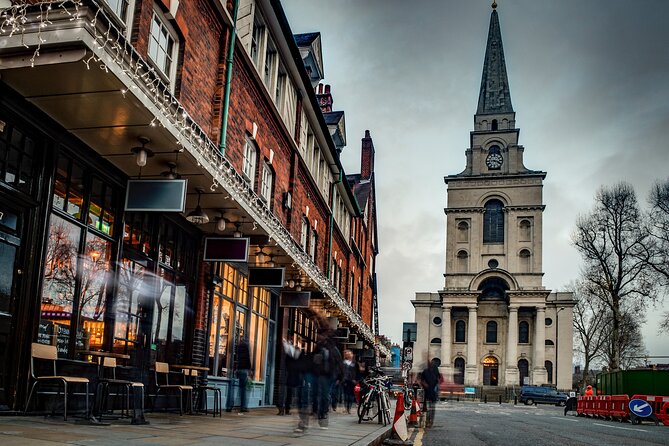
Next up: Christ Church Spitalfields, built between 1714 and 1729 to a design by Nicholas Hawksmoor. It sits on Commercial Street in the East End, and it’s listed as one of the so-called Commissioners’ Churches created after an Act of Parliament established a commission to build fifty new churches in the early 1700s.
This stop is a great pairing with the Fruit & Wool Exchange, because it shows how the neighborhood wasn’t only about commerce—it also had serious institutions and planning behind it. Again, the game asks you to search for the challenge answer by looking around.
A small consideration: this is a real church setting. Even if you’re in a themed mood, keep it respectful, keep your voice down, and avoid blocking other visitors.



The Ten Bells: a pub corner where stories get repeated
At The Ten Bells, you’re standing at a public house at the corner of Commercial Street and Fournier Street. It’s sometimes linked in Jack the Ripper discussions to victims including Annie Chapman and Mary Kelly.
Whether you treat the association as certain or just part of the case folklore, the value of this stop is how it connects the name-game to a real street corner you can actually stand at. If you like “place-based history,” this kind of stop is exactly why a walking game can feel more real than reading.
The quest keeps the same rhythm: you’ll look around and find the answer for the next step.
19 Princelet St: a small building with big migration-era connections

19 Princelet St is described as a unique cultural institution in one of London’s smallest and prettiest historic buildings. The front doors are rarely open, but the building connects to stories involving secrets, suitcases, poems, potatoes, and threads of history tied to today’s debates over migration and multiculturalism.
Unlike several other stops, the entry is noted as free. That makes it a worthwhile pause point if you like to spend time absorbing context rather than only moving through it.
The challenge here is also very “quest” in spirit: you’ll need to look around to locate the answer tied to the location.
The Old Truman Brewery: where East London turned storage into creative space
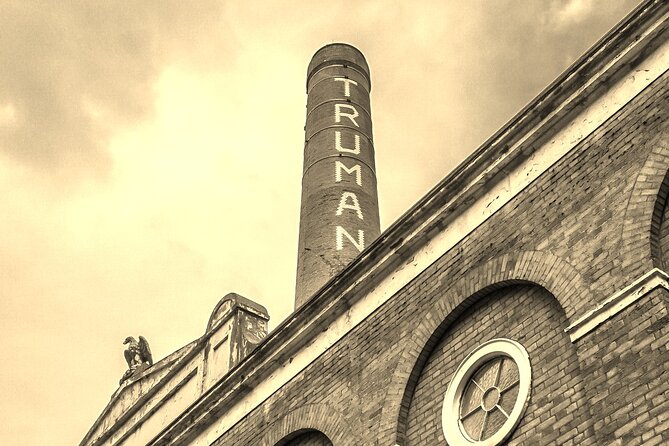
Then you reach the Old Truman Brewery, which is now an arts and media quarter. This area is described as having independent shops, galleries, markets, bars, and restaurants, all inside a regenerated complex of former brewery buildings.
One detail I like here: it’s described as transforming ten acres of vacant and derelict space into office, retail, leisure, and event areas over more than twenty years. That’s a reminder that the East End story isn’t frozen in 1888. The streets you’re walking have kept evolving.
Since the game still gives you a challenge at each stop, plan on about ten minutes here to find the answer and keep the pace steady. If you want to linger, you can do that, but the quest time budget is what keeps the total walk close to two hours.
Brick Lane Mosque (Jamme Masjid): layers of faith on one famous street
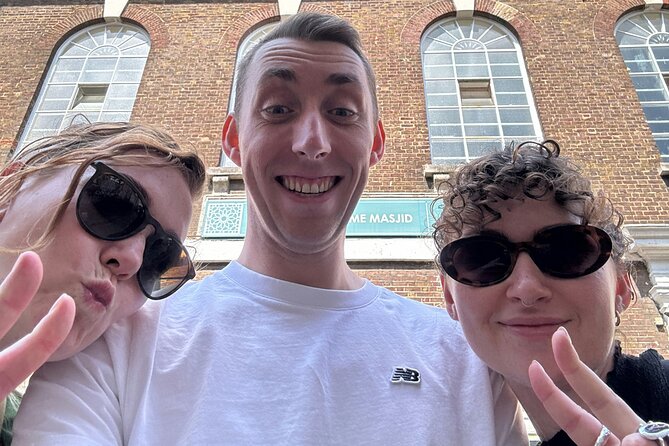
At Brick Lane Jamme Masjid (also known as the Brick Lane Jamme Masjid / London Jamme Masjid), you’re visiting a Muslim place of worship at 59 Brick Lane, on the corner of Fournier Street. The building has reportedly hosted multiple communities since the mid-eighteenth century—Christian, Jewish, and Muslim—reflecting immigration waves in Spitalfields.
The provided information also notes that the former Great Synagogue is Grade II listed, and the adjacent former school buildings are Grade II listed.
This stop is valuable because it gives you a “London layers” lens. If you’re only chasing Jack the Ripper facts, you can miss the neighborhood reality. Here, you’re reminded that many different communities lived side by side in the same streets you’re now linking to a famous crime narrative.
Again, the format stays consistent: you’ll look around for the challenge answer.
Happy Days: a possible clue site and a piece of graffiti you can track
Happy Days is described as a small London restaurant with a rich heritage. The information ties it to the Jack the Ripper story by pointing to flats in the 1880s and says it plays a major role in the narrative. It’s also identified as the site of one of the only clues reportedly connected with the criminal, and it’s where one of his most famous graffiti works is referenced, with a plaque mentioned as being visible on the game’s wall.
The key practical takeaway for you: expect this stop to be more visual and specific. The game’s instruction is still to look around to find the answer, but this is the kind of location where details can matter.
If you’re sensitive to graphic crime discussion, keep in mind that this route is themed around murders and case associations. The atmosphere here is still commercial and everyday, but the story focus won’t be “light.”
Mitre Square at 1:45am: Catherine Eddowes’ death site
In Mitre Square, the walk turns sharply from neighborhood texture into a precise moment in time. The square occupies the former cloister site of Holy Trinity Priory, demolished under Henry VIII during the Dissolution of the Monasteries. The south corner is identified as the site of the murder of Catherine Eddowes, with her body found at 1:45 in the morning on 30 September 1888.
This is one of the most emotionally loaded stops on the route because it comes with a specific time and name. For many people, that’s the “this happened here” moment that makes the whole walk feel heavier.
The game still asks you to look around for the answer, and it notes this stop has free admission.
The White Hart: the long-running pub thread in Whitechapel
Next comes The White Hart, described as the only long-standing pub left on the north side of the High Street. Its signage claims it was founded in 1721, though that date is described as uncertain. Still, it was known by 1723 when custom officials confiscated coffee concealed in a load of faggots at the White Hart Inn.
I like this stop because it anchors the story in everyday infrastructure. A pub isn’t “just a pub” on this route—it’s part of how neighborhoods functioned: meeting, news-sharing, routine.
As with several stops, you’ll look around to find the answer for the challenge.
Henriques Street (Berner Street): the third-murder street angle
The final stop area is Henriques Street, now called Henriques Street, which was Berner Street in the past. The information says Berner Street (Henriques Street today) was the scene of what’s generally accepted as the third murder committed by Jack the Ripper. It’s described as a narrow north-to-south street off Commercial Road in Whitechapel.
This is another “street geometry” stop: the narrowness and the off-main-street detail matter because crimes in city neighborhoods often happen out of view, not on broad avenues. You’ll look around to complete the last challenge, and admission here is listed as free.
What to expect from the Quest format (and why it can annoy some people)
This is a private tour/activity, meaning only your group will play. That can be a big deal if you don’t want to share your puzzle progress with strangers.
You also get an admission ticket (mobile ticket) rather than a set of paper vouchers, and the experience is designed so you play offline—you don’t need an internet connection to run the city game. It’s also described as not needing to be rescheduled, which helps if your day shifts around.
But here’s where the experience can swing. The experience includes the game mechanics, not a physical tour guide. That means you’re relying on the prompts, the challenge instructions, and your ability to read what’s in front of you.
This matters because the overall rating is 4.6 out of 5 with 10 reviews, and about 90% recommend it—so most people are happy with it. Still, there is at least one serious complaint about the walk feeling like poor value due to directions/explanations, with the person using their own search tools for clarity. So, if you know you get frustrated when instructions are vague, treat this as a “prepare your phone and pace” kind of outing.
Should you book Jack the Ripper in London: Quest Experience?
Book it if you want a themed London walk that’s self-paced, offline, and built around looking* instead of listening. It’s especially good for people who enjoy puzzles, enjoy street-level history, and like turning East End landmarks into a story you can solve step by step.
Skip it (or at least go in with eyes open) if you strongly prefer a traditional guide-led tour with constant narration and clear turn-by-turn direction help. With no physical guide, the experience lives or dies on how well the game prompts work for you in the moment.
If you fall in the first group, this is a clever way to explore Spitalfields and Whitechapel in about two hours, ending near Whitechapel Bell Foundry, with a price that’s easy to swallow.