REVIEW · LONDON
London: Guided Tour of the Natural History Museum
Book on GetYourGuide →Operated by Golden Tours - Gray Line London · Bookable on GetYourGuide
Two hours, and the whole story of life. You start with the museum security and a giraffe skeleton near the donation queue, then step into the grand hall where terracotta monkeys hint at the Owen versus Darwin story; I love the Dinosaur Gallery with Diplodocus and the blue whale skeleton hanging overhead. It’s a smart way to see the big moments without getting lost.
One thing to watch: this isn’t an official Natural History Museum tour, and there are reports of guides arriving late or not showing up. If you go, get to the meeting spot early and match your guide’s Golden Tours umbrella at the meeting spot in Evolution Garden.
In This Review
- Key highlights worth knowing before you go
- Getting Oriented at the Natural History Museum Entrance
- Bag Check, the Giraffe Moment, and the Owen vs Darwin Hint
- Dinosaur Gallery to Mammals Gallery: How the Tour Builds Evolution
- The Marine Life Section and the Blue Whale Skeleton Overhead
- Human Evolution Gallery: Fossils, Life-Sized Models, and the Big Picture
- Earth Sciences Gallery: Volcanoes, Earthquakes, and the Rock-and-Gem Facts
- Wildlife Garden and the Architecture Payoff
- Price and Value: Is $40 Worth It?
- Should You Book This Natural History Museum Guided Tour?
- FAQ
- Where is the meeting point for this tour?
- How long is the guided tour?
- What is the price?
- What’s included in the price?
- Is food or drink included?
- Does this tour include transportation?
- Is the tour wheelchair accessible?
- Is this an official Natural History Museum tour?
- FAQ
- Can I cancel for a full refund?
Key highlights worth knowing before you go
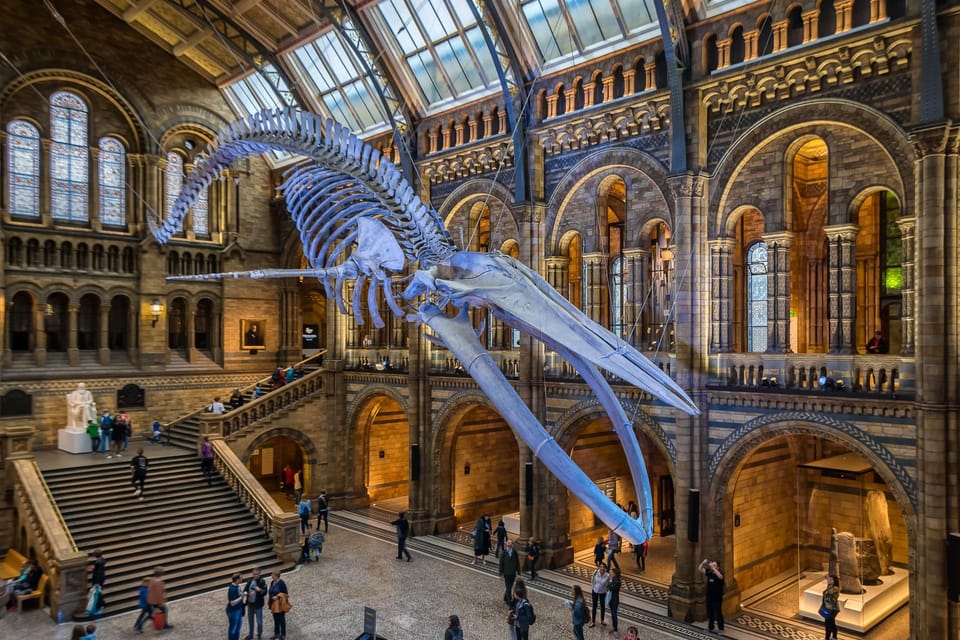
- Owen vs Darwin nods right in the grand hall through terracotta monkeys on the arches
- Dinosaur Gallery timing that gets you to Diplodocus fast, before the rooms feel chaotic
- Blue whale skeleton overhead that turns the Marine Life section into a real wow-moment
- Human Evolution stops with life-sized models plus fossil finds in one focused sweep
- Volcanoes and Earthquakes theme in Earth Sciences, with volcanic rocks and gemstones
- Wildlife Garden vibe nearby, a small break with birds and bees in the mix
Getting Oriented at the Natural History Museum Entrance
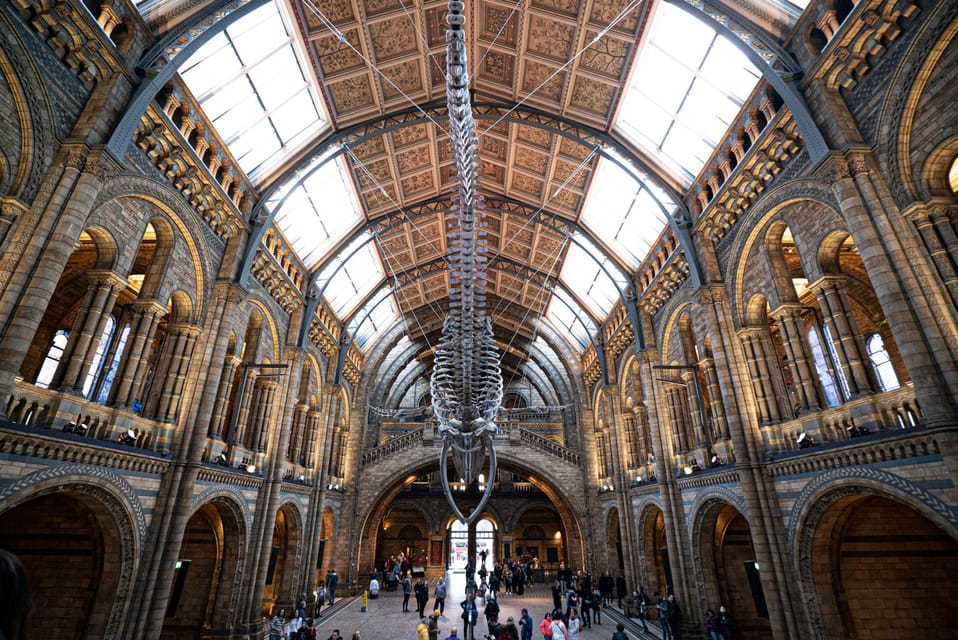
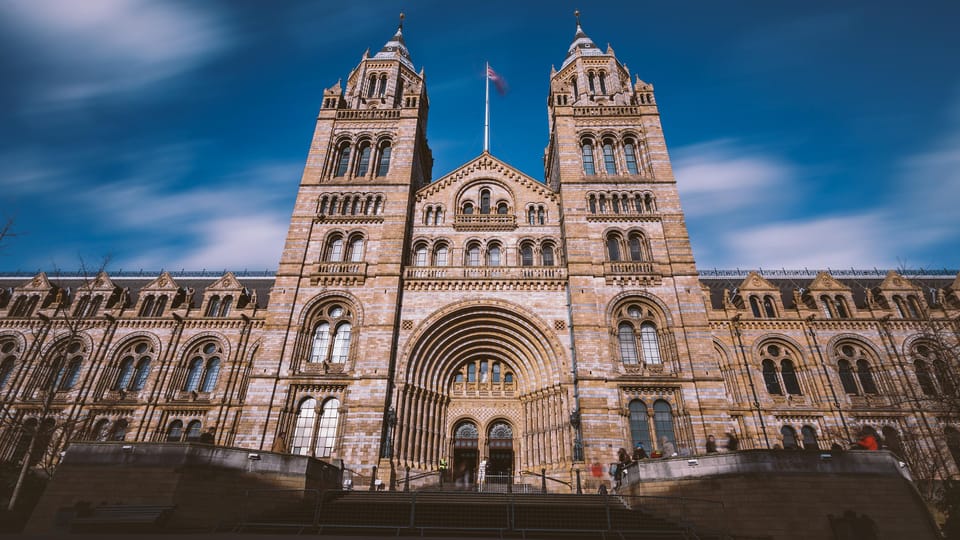
The Natural History Museum can feel like a maze until someone gives you a path. This guided visit is built around a route that hits the museum’s most memorable science stories, in a logical order that goes from life long ago to life today.
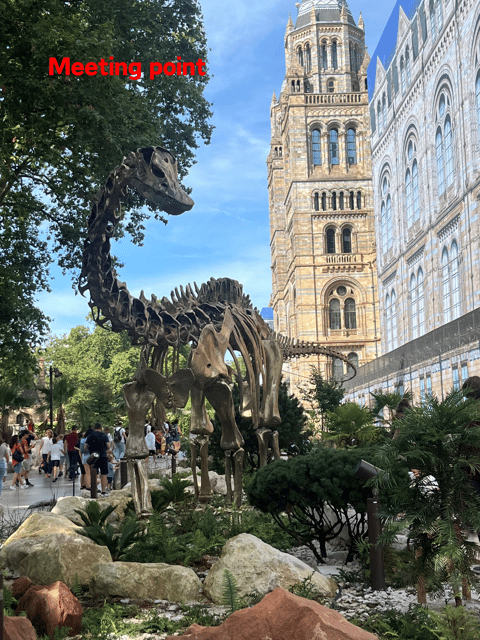
You’ll meet at the Main Entrance doors on Cromwell Road, then follow signs to the Evolution Garden meeting point. Look for a large bronze skeleton statue of a long-necked dinosaur. Your guide is positioned opposite that statue, holding a blue-and-white Golden Tours umbrella.
This matters because the museum runs on foot traffic. If you’re even a little late, you can lose the whole group. The tour also recommends arriving 15 minutes early, which is a good rule here, even if you plan to arrive “just in time.”
You can also read our reviews of more guided tours in London



Bag Check, the Giraffe Moment, and the Owen vs Darwin Hint
Before you even reach the main galleries, the tour starts with something most first-time visitors skip in their planning: the museum bag check and the contactless donations queue. In this case, it’s not just a formality. It sets the mood and gets you into the museum’s rhythm.
Right near the start, you pass a giraffe skeleton standing tall beside a taxidermy giraffe. That one pairing is a quick preview of what the museum does best: mix specimen history with science storytelling, and make it feel physical, not abstract.
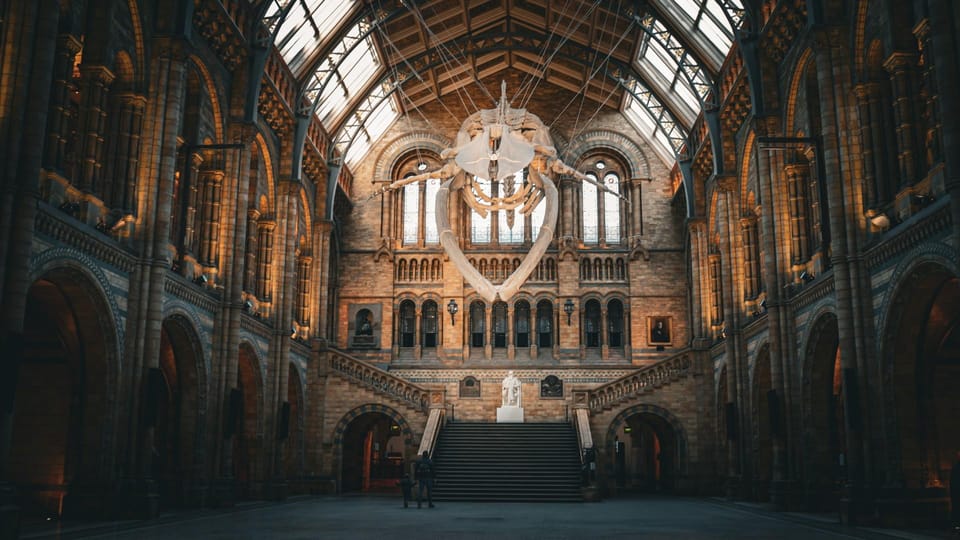
Then you enter the grand hall, where terracotta arches and columns create that classic London “big room” feeling. And the tour points out a clever detail: terracotta monkeys climbing the walls, linked to Sir Richard Owen’s rivalry with Charles Darwin. It’s a small clue, but it helps you notice the museum’s deeper angle—this place isn’t only about facts. It’s also about the people and debates behind the facts.
Practical tip: wear shoes you’ll happily walk in for two hours. Even on a guided route, the museum’s scale means you’ll rack up steps fast.
Dinosaur Gallery to Mammals Gallery: How the Tour Builds Evolution
The first major gallery stop is the Dinosaur Gallery, where you’re guided toward the big prehistoric skeletons, including the iconic Diplodocus. The value here isn’t only seeing the bones—it’s the “now what” feeling. A guide helps you move past the first wow and into understanding what you’re looking at: size, form, and why these displays exist the way they do.
From there, the tour shifts into the Mammals Gallery. This is where you’ll see taxidermy specimens and skeletons from animals like African elephants and cheetahs. The guided order is helpful: dinosaurs give you deep time, and mammals show you how evolution shaped animals that fit life on Earth right now.
If you like science explanations that connect species to environments, this part works well. It also gives you a natural break from thinking of the museum as one huge room of things to stare at. Instead, you’re following a story.
Possible drawback to keep in mind: when a guided visit works, the pacing feels great. When it doesn’t, you can feel stuck in the early galleries without enough time to enjoy later stops. So if you’re visiting during a busy period, pay attention to timing and don’t wander off to check every case on your own.
The Marine Life Section and the Blue Whale Skeleton Overhead
If you’re going for one single “wow” moment, make it this one. In the Marine Life section, the blue whale skeleton is suspended from the ceiling, so it hangs above you as you look around the gallery.
This display is powerful because it’s both dramatic and informative. You see a whale at a size that’s hard to imagine from the ground, then you’re reminded that ocean biodiversity includes creatures that are truly enormous and extremely specialized.
The guided format helps you spot patterns you might miss alone. With a guide, you’re more likely to notice how the museum connects oceans, species, and natural history rather than treating each display as a random artifact.
One more thing I like about this section: it gives your eyes a “level shift.” After dry-land fossils and skeletons, looking up at the whale changes how the space feels. That small change can make the whole tour feel less like one long indoor march.
Human Evolution Gallery: Fossils, Life-Sized Models, and the Big Picture
Next up is the Human Evolution Gallery, where you’ll see life-sized models and fossilized remains. This is often the gallery people either race through or carefully sit with. A guided route tends to steer you toward the key items so you get the core story without losing your bearings.
The focus here is on life’s diversity and what we can learn from remains and models—how humans fit into evolution rather than standing outside it. Even if you’ve seen photos of fossils online, the physical scale in the gallery can hit differently. A guide helps translate what you’re seeing into a clearer timeline in your head.
I also like that this stop connects back to earlier galleries. You’re not just jumping to “human stuff.” You’ve already been primed by dinosaurs, mammals, and marine life, so the human evolution section feels like a continuation of the same big theme: life changing over time.
You can also read our reviews of more historical tours in London
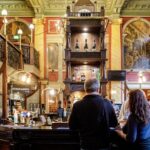

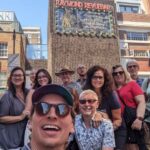


Earth Sciences Gallery: Volcanoes, Earthquakes, and the Rock-and-Gem Facts
The tour ends with Earth Sciences, including the Volcanoes and Earthquakes Gallery theme. You’ll see geological wonders like gemstones and volcanic rocks, which makes this final stretch feel more tactile and less biology-heavy.
This is a good way to balance the museum’s fossil focus. Earth Sciences reminds you that evolution doesn’t happen in a vacuum. The planet’s changing geology, climate shifts, and tectonic activity shape habitats and ecosystems over time.
The volcanic rocks and gemstone displays work especially well for people who like visual proof—things you can point to and say, that’s what it is, and here’s why it matters. If you’re into hands-on learning, you might find yourself wanting more time here, but the two-hour structure keeps the experience moving.
Small reality check: a two-hour guided tour means you’ll see the major highlights, not every gallery corner. If you’re the type who can spend an hour just reading labels, you’ll likely want to return after the tour.
Wildlife Garden and the Architecture Payoff
The tour highlights the Wildlife Garden as a haven for birds, bees, and other animals. Even if your main attention stays indoors, this is a nice counterpoint to the fossil galleries. It reminds you that evolution isn’t only something in museum cases. It’s happening right now.
As you wrap up, you’ll also notice the museum’s architecture again—terracotta details, intricate wall carvings, and that sense of legacy linking extinct and living species. The guide’s final “look back” moment can help you remember the building itself as part of the experience, not just a container.
Then you finish at the museum’s café and gift shop. This gives you a natural decompression moment: sit for a drink or snack if you want (not included in the tour price) and browse for a science-themed souvenir before you head out.
Price and Value: Is $40 Worth It?
At around $40 per person for a 2-hour guided experience, the value depends on what you want from the museum.
Here’s the honest math in plain terms:
- You’re paying for time-saving structure and a guided path through the museum’s biggest themes.
- You’re not paying for transportation or food, so those are on you.
- The museum itself is the main attraction, so if you already know your must-see exhibits, you might not need a guide.
That said, this is the kind of tour that can be genuinely worthwhile if you want connections between rooms: evolution stories that build step-by-step, plus geology that ties into the bigger picture.
The caution is that this specific operator has had reports connected to guide reliability. With a low rating and some mentions of guides not showing up or leaving early, you should plan like you’re dealing with a schedule-sensitive experience. If you’re the careful type, take screenshots of your booking and the meeting instructions, and give yourself extra buffer time.
Should You Book This Natural History Museum Guided Tour?
Book it if you want a 2-hour route that hits the Dinosaur Gallery (Diplodocus), the Marine Life blue whale skeleton, the Human Evolution Gallery, and the Earth Sciences volcano-and-gem highlights—with a guide to keep the story clear.
Skip or reconsider if you strongly need high schedule reliability, since there are reports of guides arriving late or not meeting the group. In that case, you might prefer a plan where you can still enjoy the museum independently if the group timing slips.
If you do book, go in smart: arrive early, check the meeting point details (Evolution Garden bronze dinosaur statue and the blue-and-white umbrella), and set expectations for a highlight-focused tour rather than “see everything.”
FAQ
Where is the meeting point for this tour?
Meet at the main entrance area of the Natural History Museum in South Kensington, then follow signs for Evolution Garden. You’ll see a large bronze skeleton statue of a long-necked dinosaur, and your Golden Tours guide will be opposite it with a blue and white umbrella.
How long is the guided tour?
The duration is 2 hours.
What is the price?
The price is listed as $40 per person.
What’s included in the price?
The price includes the guided tour.
Is food or drink included?
No. Food and drink are not included.
Does this tour include transportation?
No. Transportation is not included.
Is the tour wheelchair accessible?
Yes, the tour is wheelchair accessible.
Is this an official Natural History Museum tour?
No. It’s organized and operated by Golden Tours and is not the official tour provided by the Natural History Museum.
FAQ
Can I cancel for a full refund?
Yes. Free cancellation is available up to 24 hours in advance for a full refund.