Shakespeare’s London is best seen on foot. This 2-hour walking tour strings together real Shakespeare-area sites with a guide who turns the streets into scenes, and I love how quotes from the plays get worked into the walk. One guide I’m drawn to is Dee, whose delivery felt like theatre in motion, and you’ll also get the payoff of crossing the Millennium Bridge for sharp city views while looking toward major landmarks.
What really makes this feel like good value is the pacing: a small group (up to 6) means you have time to ask questions, not just shuffle along with the crowd. And the stops are chosen to connect you to multiple chapters of playhouse life, including the spot that’s now the Shakespeare Museum at The Theatre.
One watch-out: this tour includes steps and stairs and has a moderate walking requirement. It’s not recommended for mobility issues, and it’s not suitable for kids under 16, so wear solid shoes and plan on moving at a group pace.
In This Review
- Key things to know before you go
- Getting oriented at Dowgate Hill, then walking like you mean it
- Thames River to Blackfriars Playhouse Yard: the playhouses start with a view
- St Paul’s and Guildhall: quick stops that hit hard with real artifacts
- Roman walls, Silver Street, and the walk through Barbican Highwalk
- Bunhill Fields and Shoreditch: moving from playhouse sites to modern streets
- Barbican Centre: the one included indoor stop
- New Inn Yard and the Shakespeare Museum area: ending at The Theatre site
- Price and logistics: why $23.08 makes sense for what you get
- How to get the most out of the walk (without slowing the group down)
- Who should book this Shakespeare Promenade?
- Should you book this Shakespeare Promenade?
- FAQ
- How long is the Shakespeare Promenade tour?
- What does the tour cost?
- Is Barbican Centre entry included?
- Are there entry fees at other stops?
- What group size should I expect?
- Where does the tour start and end?
- Is it suitable for children?
- What should I bring and wear?
Key things to know before you go
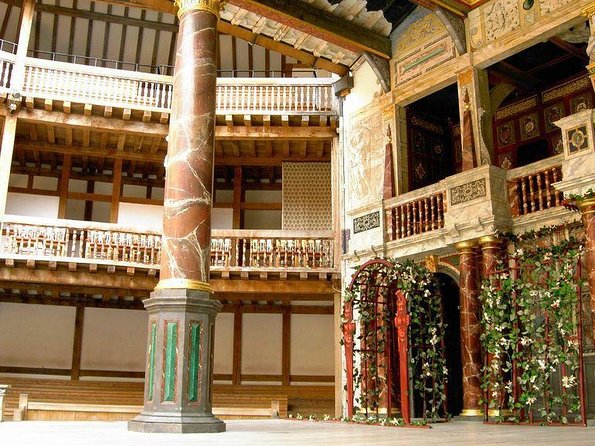
- Up to 6 people: a truly small group that leaves room for questions
- Actor guide narrator: expect theatre-style storytelling, not just facts on paper
- Millennium Bridge crossing: great views and a nice reset from narrow streets
- Barbican Centre entry included: you get inside for a short, focused stop
- Mostly free admission stops: many locations are outside, with no entry fees
- Steps/stairs on the route: bring comfortable footwear and a steady attitude
Getting oriented at Dowgate Hill, then walking like you mean it
The tour starts at The Tallow Chandlers Company, 4 Dowgate Hill (EC4R 2SH). From there, you’re off on a Thames-to-Shoreditch route that keeps you moving through different eras of London theatre. The whole experience takes about 2 hours including walking time, so it’s a smart pick when you want Shakespeare without burning half a day.
You’ll be using a mobile ticket, and the format is built for an English-language guide. It’s also close to public transport, and the end point is convenient for your next hop: New Inn Yard, outside the Shakespeare Museum, about 10 minutes from Old Street Tube (Northern Line) and 15 minutes from Liverpool Street (Central Line).
The small-group size matters more than you might think. With a maximum of 6, you don’t disappear into a sea of people, and the guide can slow down when you’re curious. That’s a big deal on a theatre-themed walk where the “why” behind each site is often the fun part.
You can also read our reviews of more tours and experiences in London.



Thames River to Blackfriars Playhouse Yard: the playhouses start with a view
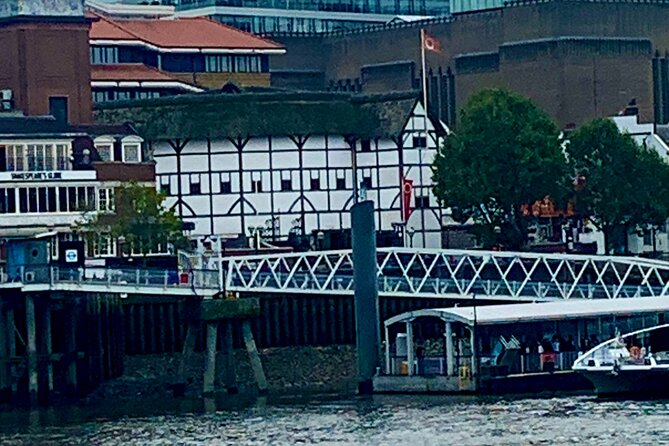
You’ll begin along the Thames path on the north bank, with time to look across the river toward the Globe Theatre. That across-the-water sightline gives you a useful mental picture: you’re not just hearing about the theatre world, you’re seeing how the Thames and the city were part of the show’s setting.
After that stretch, you continue toward Blackfriars. This part of the walk is short, but it has a strong impact because it sets up the next stop’s layers. Theatre in London wasn’t one single place—it was repeated, rebuilt, reused, and repurposed as the city changed.
Stop 2 is Playhouse Yard, focused on the Blackfriars Dominican Monastery and the 1st and 2nd Blackfriars playhouses. What I like here is the sense of continuity. You’re standing at a site where religious space and performance space overlapped in the story of London, and the guide’s job is to help you notice those shifts without turning it into a history lecture.
Even if you’re not a Shakespeare scholar, this stop works because it helps you see theatre as something physical—built on specific ground, not floating in time.
St Paul’s and Guildhall: quick stops that hit hard with real artifacts
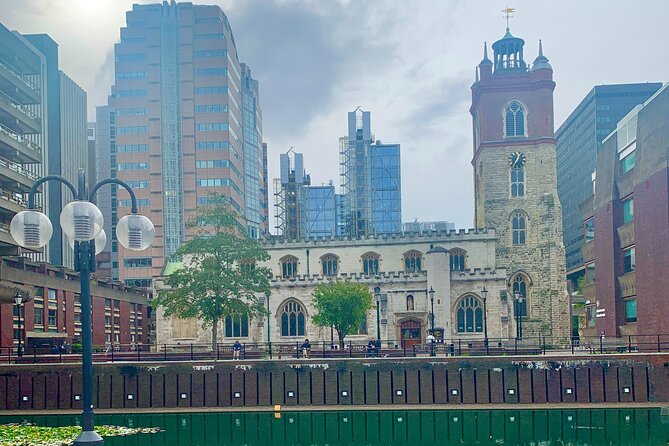
Then you’ll move through central London with a short segment around St. Paul’s Cathedral, including walking along Cheapside and up Milk Street. This is one of those “we’re not going deep, but you get the angle” moments. You get to frame the city’s scale while keeping the focus on the Shakespeare route.
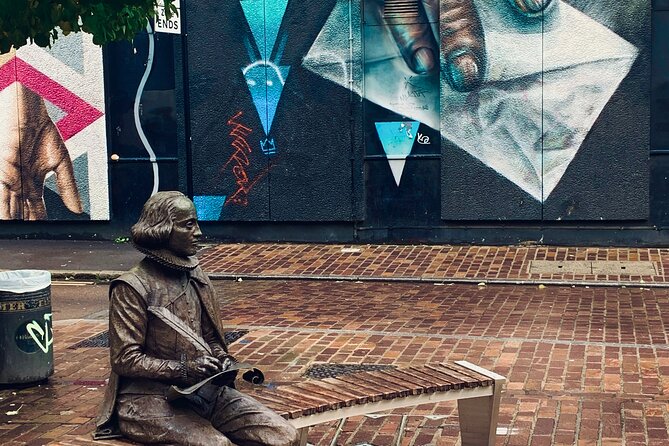
Next is Guildhall, where the walk features the Heminges and Condell Shakespeare statue on Love Lane. This matters because it connects Shakespeare’s legacy to the people tied to preserving his work, and it links directly to the presence of a Shakespeare folio held housed at the Guildhall. It’s a neat change of pace from plain street-level viewing: here you’re meant to look at something made for remembrance.
This stop is also brief, but it’s built to spark conversation. If you’re the type who likes to ask, this is a good moment to do it—how people protected the work, how fame survives, and how “book” culture ties back to “stage” culture.
Roman walls, Silver Street, and the walk through Barbican Highwalk
As you head to Noble Street and the Roman wall of Londonium, you get a rare theatre-adjacent scene: ruins. That contrast is useful. It reminds you that Shakespeare’s London was happening over older London layers, and the walk nudges you to notice how the ground itself carries the timeline.
Right around this area, there’s also a plaque showing Shakespeare’s Lodgings on Silver Street. Even without a deep stay, it’s the kind of marker that makes the whole “where did people live” question feel real. You can look at the street and picture an everyday rhythm, not just the grand moments.
From there, the tour climbs into the Barbican world via the Barbican Highwalk. This is a walkway through the Barbican estate, and the bonus is the views—plus the chance to hear about the Barbican estate and the Barbican Centre nearby. I like this stop because it shifts you above street level. Your eyes get a break, and the guide can connect modern London architecture back to the theatre theme without forcing it.
A note for your legs: this part includes walking time that can include stairs. If you’re steady on your feet, it’s a great section. If you’re not, it can feel like the tour expects more mobility than you have.
Bunhill Fields and Shoreditch: moving from playhouse sites to modern streets
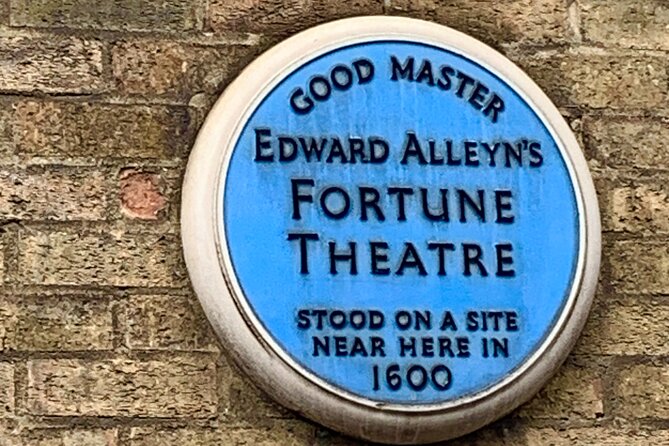
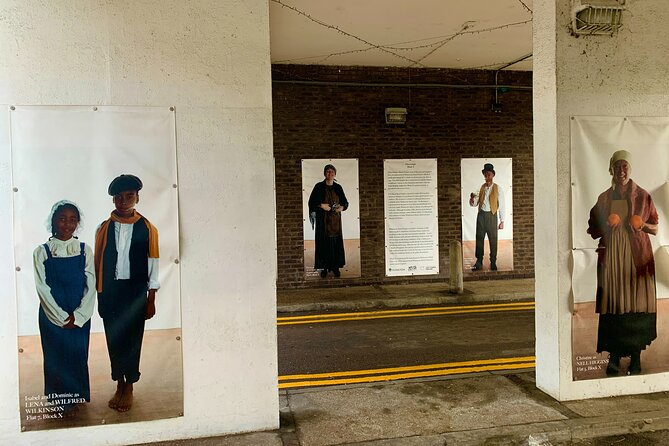
Next you’ll walk up Whitecross Street and see the site of the Fortune Playhouse. Then you cross into Shoreditch territory, and the guide talks about the history of the burial ground there. That combination is smart: you’re seeing performance-linked ground, then hearing how the same neighborhoods carried very different functions.
Shoreditch is where the tour shifts from “historic sites” energy to “modern London still on top of the past.” You’ll walk through the district toward Curtain Road. This last stretch helps you land your brain back in the present: you’ve moved through sites of performance, preserved memory, and older layers of the city, and now you’re walking the current streets that still connect to it all.
It’s also a good moment to think about your next steps. If you want to keep exploring, Shoreditch has plenty of day-walk options, and the tour ending helps you roll right into that.



Barbican Centre: the one included indoor stop
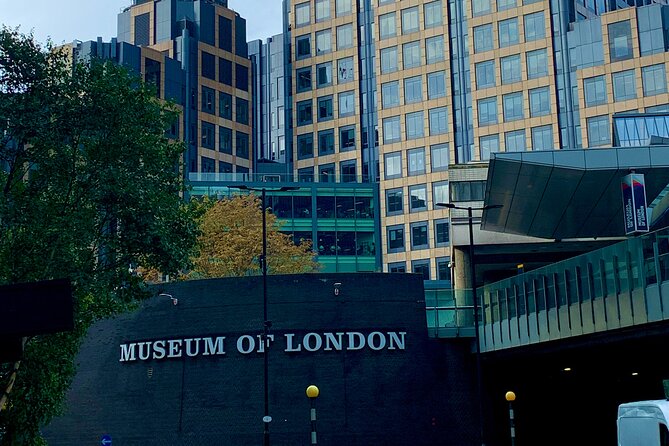
The tour gives you time at the Barbican Centre, including an inside visit (about 10 minutes built into the route), and there’s also a 20-minute interval at Barbican. This is where restrooms are available, which is a practical win if you’re trying to keep your day on track.
The Barbican stop is also the place where the guide connects the venue world back to theatre. You’ll learn about the Barbican Centre and how it’s the London home of the Royal Shakespeare Company. Even with a short visit, it’s a useful bridge between Shakespeare’s era and modern professional staging—without you needing to sit through a full museum experience.
If you like tours that balance outdoor sites with one short indoor “anchor,” this is that.
New Inn Yard and the Shakespeare Museum area: ending at The Theatre site
The final thematic highlight is New Inn Yard, where you’ll find the site of the first playhouse called The Theatre, now the location for the Shakespeare Museum. This is one of the tour’s most rewarding stops because it’s the moment you can feel the theme click into place: the route isn’t just about scattered references, it points toward a physical place tied to early playhouse life.
You’ll finish in New Inn Yard, outside the Shakespeare Museum, and it’s nicely connected to public transport. That makes the ending feel flexible—walk a bit more in the area, then grab the tube back across town.
This also keeps the tour from feeling like it stops abruptly. The ending point is meaningful, not just a random sidewalk turnover.
Price and logistics: why $23.08 makes sense for what you get
At $23.08 per person for about 2 hours, this tour is priced like a “guide + walking + storytelling” experience, not a bundle of paid attractions. And that’s a big part of the value.
Most stops are free in the sense that you’re not paying separate entry fees to see them. The only place where the tour clearly includes paid access is Barbican Centre, which is included in the experience. So even if you’re watching your budget, you’re not paying repeatedly just to stand in front of things.
You should also factor in the group size. With up to 6 people, your money goes more toward the guide’s time and your ability to ask questions. A packed group tour can feel like you’re paying for the street noise. This one gives you more attention per person.
How to get the most out of the walk (without slowing the group down)
This is a walking tour with road crossings and steps and stairs, so comfort matters. I’d plan to wear walking footwear you already trust, not “special shoes.” The tour notes say an umbrella or rain mac may be required, so bring one if clouds are in the forecast.
Also, plan for “real life”: the tour does not provide food or refreshments. Bring your own bottled water so you can keep moving without having to hunt for something right when the group is ready to continue.
If you want the stories to really land, ask questions at the moments when the guide is already setting up the next site. The tour’s format is built for interaction, and you’ll get more out of it if you treat it like a conversation rather than a lecture.
And because it’s theatre-themed, pay attention when quotes are woven in. Even if you only catch a line or two, it helps connect the physical sites to what the plays felt like in daily life.
Who should book this Shakespeare Promenade?
This tour is a great match if you:
- Love Shakespeare-related landmarks and want a focused walk through key playhouse areas
- Enjoy theatre-style storytelling and want more than basic plaques
- Prefer small-group experiences where you can ask questions
It’s probably not the best fit if you:
- Need step-free walking or you have difficulty keeping pace (the route includes steps and stairs)
- Are looking for a kids’ outing (it’s not suitable for under 16)
- Want a low-effort sit-down museum day (this is a walking route)
One more practical point: the tour includes a 20-minute Barbican interval, which is helpful if you need a breather. But the overall structure still expects you to walk consistently for the full 2 hours.
Should you book this Shakespeare Promenade?
If you want Shakespeare without the heavy slog, I think this is worth booking. The mix of outdoor playhouse-related sites, the Millennium Bridge views, and the stop at The Theatre/Shakespeare Museum gives you a satisfying sense of place. Add a small group and an actor guide style, and you get a walk that feels like it has momentum.
But if you’re sensitive to stairs or walking time, don’t force it. This one is best when you can move comfortably and enjoy the journey between stops.
If you’re ready for a brisk, story-led London walk that connects multiple playhouses in a single route, this Shakespeare Promenade is a strong value pick.
FAQ
How long is the Shakespeare Promenade tour?
It’s about 2 hours including walking time.
What does the tour cost?
The price is $23.08 per person.
Is Barbican Centre entry included?
Yes. Barbican Centre is included with admission as part of the experience.
Are there entry fees at other stops?
The tour indicates no entry fees, with admission tickets listed as free for the stops.
What group size should I expect?
The tour has a maximum of 6 travelers.
Where does the tour start and end?
It starts at The Tallow Chandlers Company, 4 Dowgate Hill (EC4R 2SH) and ends in New Inn Yard, outside the Shakespeare Museum. It’s about 10 minutes from Old Street Tube and 15 minutes from Liverpool Street Tube.
Is it suitable for children?
No. It is not suitable for children under 16.
What should I bring and wear?
Wear walking footwear, consider an umbrella or rain mac, and bring your own bottled water.