London changes its mood after dark. This 2-hour, 7:30 pm ghost walk threads haunted London landmarks with stories that run from murderous queens to demonic dogs, and it’s built around photo-friendly stops so you’re not just listening—you’re also capturing the skyline. The vibe stays very horror-forward, but it’s also tied to real places you can point to on a map.
One thing to plan for: the route is pretty easy, but there are a small number of stairs. If you’re very sensitive to steps (or you’re pushing a stroller), you’ll want to take your time at those brief moments.
In This Review
- Quick hits on the Fading Light London Ghost Walk
- A 7:30 pm ghost walk that hits the right balance
- Where you meet near Cheapside and end by the Thames
- The first stop: Christchurch Greyfriars and Queen Isabella
- Holy Sepulchre: the church that turns grave robbing into a horror story
- Old Bailey and Newgate: courts, prisons, and the ghosts outside
- Amen Court and the Black Dog of Newgate
- Temple Bar: the gateway with a ghost story retold by the eyewitness
- St. Paul’s Cathedral and Paternoster Row: a church area with witchcraft rumors
- St Mary Le Bow: famous church, creepy events, and more atmosphere
- Bank of England and Sarah Whitehead’s haunting
- Underground ghosts at St Mary Woolnoth and Fish Street Hill
- The Monument to the Great Fire of London: the finale you can see
- London Bridge by the Thames: wrapping up the bridge ghost story
- Price and value: what $16.44 buys you
- Who should book this ghost walk
- The operator note I appreciated about keeping tours running
- Should you book the Fading Light London Ghost Walk?
- FAQ
- What time does the Fading Light London Ghost Walk start?
- How long is the tour?
- What does it cost per person?
- Is the tour offered in English?
- Where do I meet and where does the walk end?
- Is the walk easy to do?
- What’s the maximum group size?
- Do I need to pay admission at each stop?
- Is there free cancellation?
Quick hits on the Fading Light London Ghost Walk
- 2 hours of guided storytelling with stops at major sites around central London
- Photo breaks at recognizable landmarks as you walk
- Haunted legends mixed with local past at churches, courts, and gateways
- Small group size (maximum 30 travelers) that keeps the tour personal
- No paid entry needed at the stops shown for this walk
- Guided by a ghost hunter and horror author with an enthusiast’s tone
A 7:30 pm ghost walk that hits the right balance
This walk is made for evenings. Starting at 7:30 pm helps the city feel more cinematic, especially when you’re outside big old stone buildings that look even bigger in low light. You’re not rushing through London like a checklist. Instead, you get short, focused stops where the guide connects the location to a haunting—then you move on.
I like that the stories lean into horror without abandoning the “how did this place become famous?” angle. Queen Isabella, grave robbing, Newgate’s underworld, and a string of church legends give you a full-night theme rather than a random set of creepy facts.
The format also makes it easy to follow along. You’re usually only a few minutes between stops, so the story momentum stays strong.
You can also read our reviews of more walking tours in London



Where you meet near Cheapside and end by the Thames
You meet at 150 Cheapside, London EC2V 6ET, then finish at Saint Magnus House, 3 Lower Thames St, London EC3R 6HD. The closest tube station is Monument, and the walk ends close to the river, with London Bridge within sight at the final stop.
Why this matters: you’re starting in the City and ending near the Thames. That’s convenient if you’re already exploring this area, and it means the walk closes with a proper “London at night” payoff instead of turning back the way you came.
Bring a phone for the mobile ticket, and expect the guide to give you directions to the nearest underground station after the tour ends.
The first stop: Christchurch Greyfriars and Queen Isabella
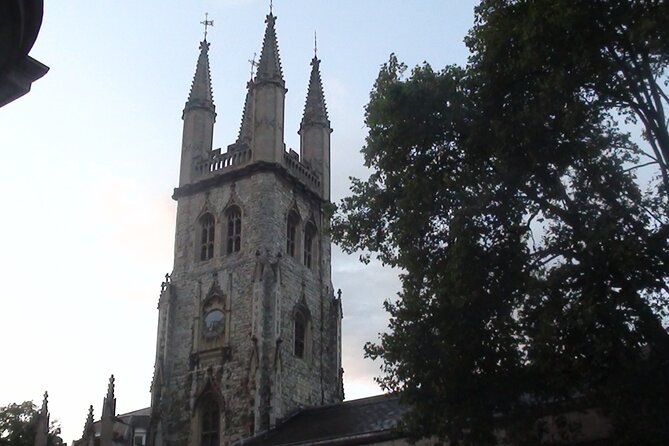
The walk kicks off at Christchurch Greyfriars Church Garden, and right away you get a famous name: Queen Isabella, wife of King Edward II. The story links her to the nickname She Wolf of France, turning a royal figure into something darker and more dangerous.
This stop sets the tone well. It’s close to a church setting, so the atmosphere feels natural, not forced. And because it’s an exterior garden space, it’s an easy place to look around before you start covering more ground.
If you’re the type who likes your horror with a royal twist, this first scene lands fast. It also gives you an early landmark to orient yourself, which helps for the rest of the walk.
Holy Sepulchre: the church that turns grave robbing into a horror story
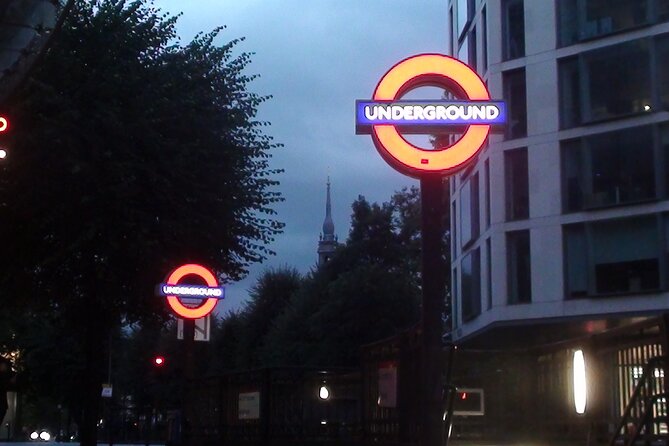
Next you head to Holy Sepulchre London, described here as the city’s largest parish church. The haunting focus isn’t just spooky ghosts—it’s the grisly practice of grave robbing, which became widespread in the late 1700s and early 1800s.
This is a smart angle for a ghost walk. Instead of only relying on supernatural scares, the guide frames the horror through what people did to bodies and the fear that followed. You get the “why would anyone be afraid of this place?” logic, which makes the stories feel less like camp and more like a real creep-factor.
You’ll also get a change of scene from a church garden into a bigger church environment. Even if you’re not going inside, the stop still works because it’s built around the building’s identity.
Old Bailey and Newgate: courts, prisons, and the ghosts outside
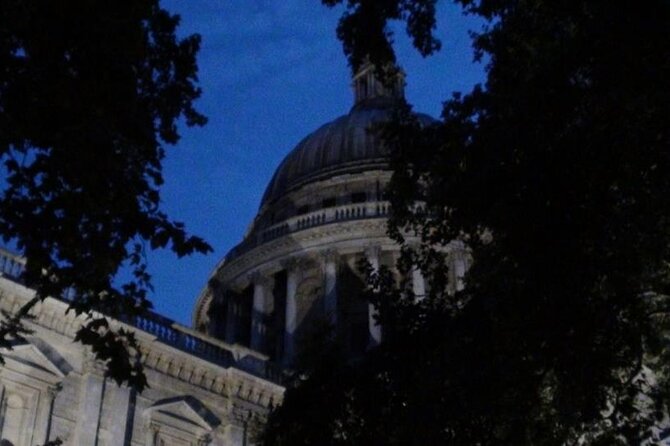
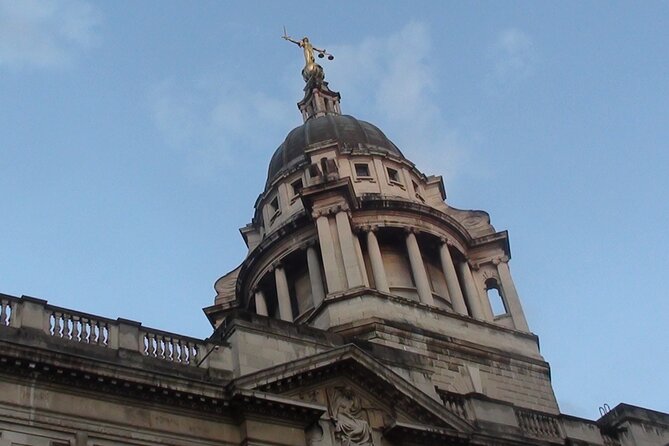
At Old Bailey, you hear about its connection to Newgate prison, once the location of the dreaded prison. The story then shifts toward the ghosts said to haunt the area.
Old Bailey is one of those places where history is sitting right on the pavement. Standing outside, you can almost feel the weight of the legal system and the punishment that came with it. The guide’s job here is to connect that serious setting to something eerie, and the Newgate angle helps a lot.
If you’re into crime stories—especially ones tied to London’s most famous institutions—this stop is a highlight of the “underworld” thread running through the walk.




Amen Court and the Black Dog of Newgate
From the Old Bailey area, you move to Amen Court, where the theme becomes a demonic entity: the Black Dog of Newgate. This stop is framed as the lair of the creature, with the guide tying the dog to the terrible crime it’s said to have been born from.
This is where the tour leans hardest into horror imagery. A “demon dog” is the kind of legend that sticks, especially after you’ve just heard about prison and fear. It also helps with variety: you’ve got royal ghosts, grave crime, and court history—now you get a monster-story interlude.
Tip for photos: because this is a smaller lane/court area compared to the big streets, don’t expect wide landmark shots. Instead, aim for close, moody angles that capture architecture and shadows.
Temple Bar: the gateway with a ghost story retold by the eyewitness
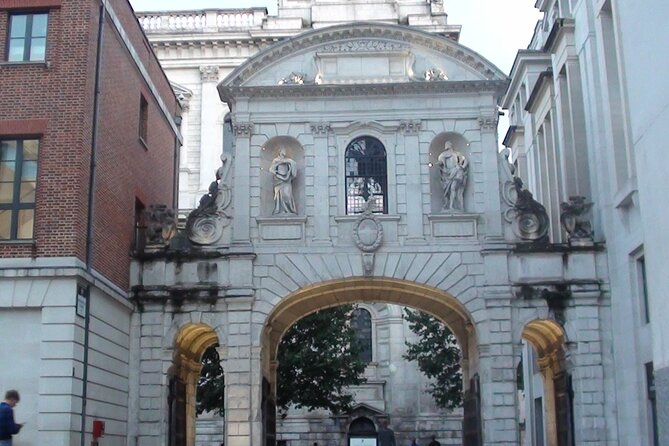
Next comes Temple Bar, described as the last of the London gateways. The guide tells its history and also shares a ghost story retold by someone who experienced the event.
That “retold by the person who was there” detail matters. Eyewitness-style narration usually feels more grounded than a pure legend. Even if you don’t believe in ghosts, you can still enjoy the human element: how one person interpreted something strange, and how that story survived.
This stop also works for orientation. Temple Bar is a recognizable “anchor” point, which helps you picture where you are as you move toward St. Paul’s and the City’s core.
St. Paul’s Cathedral and Paternoster Row: a church area with witchcraft rumors
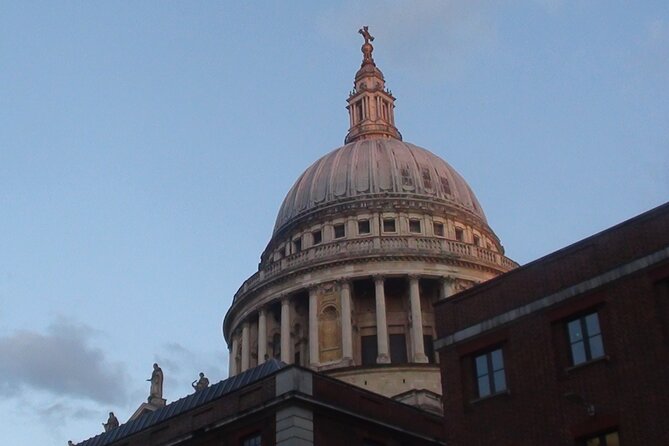
The route passes St. Paul’s Cathedral, and you stop outside to hear a bit of its story and a haunting tied to it. Then you continue to Paternoster Row, still in the shadow of St. Paul’s, where you hear about an open-air pulpit and connections to necromancy and witchcraft.
This is one of the tour’s clever combinations: a huge iconic landmark (St. Paul’s) paired with a less famous but still spooky rumor network (witchcraft and necromancy). It’s the kind of pairing that keeps the story from repeating itself.
Also, photo-wise, this section tends to be strong. St. Paul’s gives you a “big London” background, and the guide’s pacing creates natural pauses for shots without feeling like you’re breaking the flow.
St Mary Le Bow: famous church, creepy events, and more atmosphere
You then move past St Mary Le Bow Church and stop to hear a brief history and some creepy events said to have taken place over its long timeline.
This is the tour’s “local legend” mode. It’s not just one massive headline story. It’s a series of smaller, unsettling moments tied to a church that has been part of London life for centuries.
If you like your ghost stories the way you’d like local folklore—specific places, named buildings, repeated rumors—this stop feels like it belongs.
Bank of England and Sarah Whitehead’s haunting
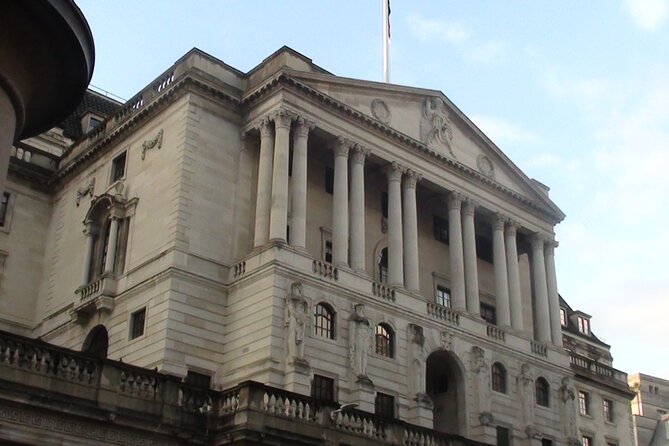
At the Bank of England, the guide brings you from finance to fear with the story of Sarah Whitehead, described as a tragic ghost said to have haunted the location since the early 19th century.
This is a great contrast stop. London is famous for mixing old and new, and the Bank is the perfect place to show that even “serious” institutions can carry dark legends. The Sarah Whitehead thread gives you a more character-driven haunting than some of the monster-style stories.
If you want the tour to feel like more than Victorian spooky talk, this stop adds a distinctly human anchor.
Underground ghosts at St Mary Woolnoth and Fish Street Hill
Next you get into London underground hauntings at St Mary Woolnoth Church, with stories about mysterious events and plague-related fears tied to the station area. Then you continue to Fish Street Hill, one of London’s famous ghost stations, where you hear about the station’s short-lived history and supernatural events linked to it.
This section is a fun change of pace. It also makes the walk feel more “London-specific,” because these aren’t generic ghost themes. They’re tied to names and places associated with the city’s transit story and the spooky way people interpret it.
Practical note: because these are station-related stops, pay attention to where you stand and how you move with the group. The tour is easy overall, but staying aware helps you get the best viewing angles without slowing everyone down.
The Monument to the Great Fire of London: the finale you can see
You then stop by the Monument to the Great Fire of London, where you hear about the Monument’s history and the Great Fire itself. The fire story is a natural ramp up toward a dramatic ending.
Even if you’ve heard about the Great Fire before, tying it into a ghost walk works. It’s not only about supernatural fear. It’s also about catastrophe—and the way catastrophe turns into lasting legend.
From here, the mood shifts from “creepy building stories” to “big-city aftermath,” which sets you up for the Thames finish.
London Bridge by the Thames: wrapping up the bridge ghost story
The final stop takes you to London Bridge, at the banks of the Thames, where London Bridge is within sight. You hear the bridge’s history and a ghost story connected to it.
This ending is satisfying because it closes the loop: you started in the City with churches and courts, then you crossed through the middle of London, and you land by the river. It’s a classic travel-feeling moment—walking stories all the way into a landmark finale.
If you’re planning a late dinner after, this is also convenient. You’ll be done right near central areas that are easy to reach from Monument.
Price and value: what $16.44 buys you
At $16.44 per person for about 2 hours, this is strong value if you want an evening activity that mixes history locations with real storytelling.
Here’s what you’re really paying for:
- A guide who’s a ghost hunter and horror author, so the tone is built for horror fans rather than generic sightseeing.
- A sequence of named stops tied to London legends, not just one haunted location.
- A route paced for night walking, with mobile ticketing and a practical number of stops.
Also, the stops are marked as admission ticket free. That means you’re not juggling entry fees at each point. You still get the drama of the buildings, but without the added cost and time sink of constant admissions.
At this price, I’d only skip it if horror stories aren’t your thing. If you like the lighter side of fear—murder queens, demon dogs, and city legends—this is a good deal.
Who should book this ghost walk
This tour fits best if:
- You want a London night plan that isn’t only pubs or museums.
- You like horror stories that still point you to real buildings and places.
- You prefer short, frequent storytelling moments over one long lecture.
It also works well as a couples activity or a fun group outing, since the tour caps at 30 travelers and stays easy to manage. If you’re traveling solo, you’ll likely find it’s simple to follow along and meet fellow fans of spooky London.
If stairs are a concern, plan to go slowly at the few stepped moments. The walk is described as pretty easy overall, but it’s not fully flat.
The operator note I appreciated about keeping tours running
One detail I liked from the guide/operator interaction I saw: when a small booking happened, the guide still emphasized that the walk would go ahead. It’s a small thing, but it signals they take the experience seriously and communicate clearly when group size is small.
Should you book the Fading Light London Ghost Walk?
If you want an evening that feels like London has a secret life, this is an easy yes. The pricing is reasonable, the route is manageable, and the story style is built for horror lovers—murderous queens, demon dogs, and haunted institutions included.
Book it if you enjoy ghost stories tied to specific places and you like taking photos while you walk. Skip it only if you want a purely historical tour without the supernatural framing, or if you’re uncomfortable with the small amount of stair climbing.
FAQ
What time does the Fading Light London Ghost Walk start?
The start time is 7:30 pm.
How long is the tour?
The tour lasts about 2 hours.
What does it cost per person?
The price is $16.44 per person.
Is the tour offered in English?
Yes, it’s offered in English.
Where do I meet and where does the walk end?
You meet at 150 Cheapside, London EC2V 6ET, and the walk ends at Saint Magnus House, 3 Lower Thames St, London EC3R 6HD. The nearest underground station is Monument.
Is the walk easy to do?
Most travelers can participate. The walk is pretty easy, but there are a small number of stairs.
What’s the maximum group size?
The maximum is 30 travelers.
Do I need to pay admission at each stop?
Admission at the stops is listed as free.
Is there free cancellation?
Yes. You can cancel up to 24 hours in advance for a full refund. If you cancel less than 24 hours before the start time, it isn’t refunded.