REVIEW · LONDON
Brixton Self-Guided Music Walking Tour – Guided By Historian
Book on Viator →Operated by Vidi Guides · Bookable on Viator
Brixton sounds like a storybook. This self-guided audio walk pairs a local historian and musician with street-level stops that connect Brixton’s black heritage, Windrush Square, and music landmarks. It’s designed for a quick, 50-minute loop you can run on your own schedule, starting at St Matthew’s Church and ending right where you began.
I especially like the offline mode with GPS, so you can download ahead and keep moving even if your signal is weak. I also like how it lets you go at your own pace while you listen, pause, and look around when something catches your eye.
One thing to watch: you’ll want to plan for phone basics. Earphones aren’t included, and if you arrive without downloading or getting the app started clearly, you may waste time figuring it out instead of walking the route.
In This Review
- Key things to know before you walk
- Why this Brixton music walk makes sense
- Starting fast: mobile ticket, offline download, GPS map
- St Matthew’s Church, Brixton Hill: the roots behind the sound
- Dogstar: one venue, many eras of change
- Brixton Market and Electric Avenue: the song’s real-world context
- David Bowie memorial: an icon, a local tie
- Phonox: club culture and the way venues evolve
- Windrush Square: the human story in the middle of music
- Timing and pacing: make the most of 50 minutes
- Price and value: what $6.84 buys you
- Practical checklist before you set off
- Who should book this Brixton audio walk?
- Should you book this Brixton Self-Guided Music Walking Tour?
- FAQ
- FAQ
- How long is the Brixton self-guided music walking tour?
- How much does the tour cost?
- Where does the tour start and end?
- When is the tour available?
- Do I need internet to use the audio during the walk?
- Does the tour use GPS navigation?
- Are earphones included?
- Are the tour stops free to enter?
- How many people can join?
Key things to know before you walk

- Historian-led audio with a music angle: not just plaques, but stories tied to the neighborhood’s sound
- Offline download + GPS: fewer worries about data and fewer chances of getting lost
- A tight 50-minute circuit: a doable taste of Brixton without turning your day into a project
- Music venues and pop-culture stops: Dogstar, Phonox, Electric Avenue, and a David Bowie mural
- Windrush Square at the heart of it: the route includes the struggles behind the music and change
- Small group cap (up to 10): even self-guided, it signals a more controlled rollout than a mass free-for-all
Why this Brixton music walk makes sense

Brixton can feel like a lot at once. Markets, churches, murals, and music venues sit side by side in South London, and that’s the point of this tour format: it uses a short route to give you a framework for what you’re seeing. Instead of treating Brixton as one generic stop on a London list, the audio connects the neighborhood’s cultural and music shifts to specific places on the street.
The tour’s themes are clear from the start. You’ll hear about Brixton’s black heritage, the Windrush generation, and how the area’s reputation grew alongside its changing music scene. You also get stops tied to iconic figures and lyrics, including David Bowie and Electric Avenue—two cultural reference points that help a first-timer understand why Brixton has mattered for decades.
For me, the best part is the pacing: you get a tight walk where each stop is only about 5 minutes. That keeps the experience from dragging, and it makes it easy to fit into a busy day—especially if you’re already planning to explore this part of London.
You can also read our reviews of more walking tours in London



Starting fast: mobile ticket, offline download, GPS map
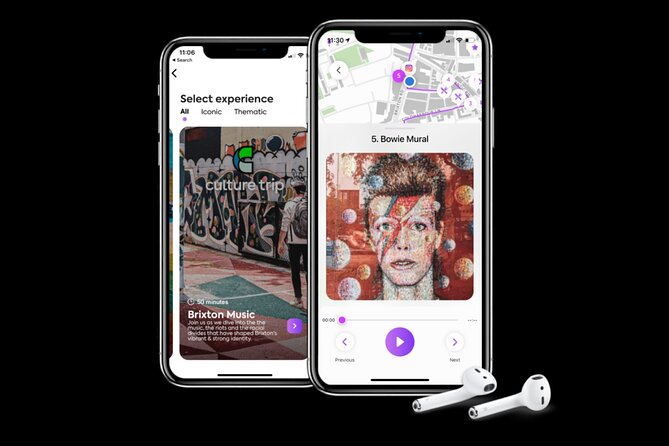
This is an app-based tour with a mobile ticket, so your phone becomes the key. The good news is you don’t need WiFi during the walk if you download ahead. The tour also uses location-aware GPS mapping, which helps you find the stops without constantly checking your map app.
That offline + GPS combo is exactly what you want in London. Streets move fast, signage can be hit-or-miss, and you don’t want your walk interrupted by loading spinners. The tour also gives you on-the-spot guidance for where to go next, which means you can keep your momentum.
Two practical cautions. First, earphones are not included, so bring wired headphones or charge your Bluetooth buds before you leave. Second, one of the biggest friction points reported by past users is confusion about how to start the audio once they arrive. Your best defense is simple: access your tour on the phone before you reach St Matthew’s Church, and confirm the audio is downloaded in advance so you’re not troubleshooting with poor signal.
St Matthew’s Church, Brixton Hill: the roots behind the sound
Your walk begins at St Matthew’s Church. This first stop matters because it sets the background. The audio traces the roots of the neighborhood and links them to the birth of popular Brixton music movements and artists. In other words, it gives you a starting lens before you hit the venues and famous streets.
If you’re the kind of traveler who likes to understand where a music culture came from—not just what it produced—this opening stop is the right move. A church location also works well for listening. The area feels like a real, lived-in community space, not a curated museum corridor.
How long to linger here: plan on about 5 minutes for the audio moment, but you can stretch it if you want a quick look around the church setting. The tour lists this stop as admission-free, so you’re not paying to access the area—just showing up and pressing play.
A small consideration: because this is self-guided, you’ll be doing the mental work of switching from audio to street observation. If you’re tired or juggling multiple stops in the day, you might want to keep expectations simple: listen first, then look.
Dogstar: one venue, many eras of change
Next up is Dogstar, an iconic music venue with a story about how it changed with the times. The stop is short—again, about 5 minutes—but it’s placed where it can do real work: you move from origins to a real-world music address, then get a sense of how places adapt as the city around them evolves.
This kind of stop is especially useful if you’re trying to understand Brixton as more than a name. Venues like Dogstar represent the bridge between community culture and mainstream attention. Even if you don’t catch a live show, the audio can help you read the street like a timeline.
One practical note: Dogstar is a working venue, so the frontage might feel different depending on what’s happening that day. The audio stop is designed to be quick and flexible, but if you want more quiet time to listen, pick a moment when the sidewalk isn’t crowded.
Brixton Market and Electric Avenue: the song’s real-world context
Then you hit Brixton Market on Electric Avenue, where the tour directly plays with a familiar reference: yes, we all know the song. But the audio’s job here is to connect the lyric-level fame to the street-level meaning.
This is one of the most satisfying stops for casual music fans and serious culture nerds alike. Electric Avenue isn’t only a landmark; it’s a corridor where daily life and pop culture overlap. If you listen closely, you’ll pick up how neighborhoods get defined by sounds, media, and community identity all at once.
Plan for about 5 minutes at this stop. The tour is listed as admission-free, which is good news if you’re trying to keep costs down while you explore. Also, this is where you’ll likely want to look up from your phone for a moment and take in the street energy before you move on.
Tradeoff to consider: Electric Avenue can get busy. If you’re trying to listen clearly, you may need to step to the side for a minute while the audio runs.
You can also read our reviews of more guided tours in London






David Bowie memorial: an icon, a local tie

After Electric Avenue, you pause at a David Bowie memorial—a mural tribute that connects the global legend back to Brixton. This stop is also about 5 minutes, and it’s built to do one thing well: give the Bowie reference a physical anchor so it feels less like distant pop trivia.
Even if you’re not a Bowie superfan, the audio framing here helps you see why he’s part of Brixton’s story. Mural tributes work best when they’re treated as starting points, not end points. The tour uses this stop to steer you back toward the neighborhood’s role in shaping artists and audience culture.
Practical tip: take a quick photo when you hear the Bowie cue in the audio. The tour also mentions Instagram-style photo hotspots, so it’s tuned for visuals. Just don’t let the photo moment crowd out the listening—this is one stop where the audio adds the context behind the image.
Phonox: club culture and the way venues evolve

Next comes Phonox, another music-related landmark. The audio shares a bit more about this legendary clubbing venue, giving you the context behind what people show up to hear and where the scene fits into the wider neighborhood story.
At about 5 minutes, the tour keeps this stop efficient. Still, it can change how you look at the place. Instead of viewing a venue as a single night out, you start thinking about it as a space with a history: how it has served different music moods across time and how it’s part of Brixton’s ongoing transformation.
Here’s a consideration: because this is self-guided, you’re relying on your own judgment to decide when to move on. If you’d like more than the short audio snippet, you can always spend extra time nearby, but the official route is designed for a clean 50-minute loop.
Windrush Square: the human story in the middle of music

The final stop is Windrush Square, where the audio zooms in on the Windrush generation and their struggles. This is the stop that gives the whole route weight. It ties the music landmarks and pop references to the real human history that shaped who lived here, what they faced, and how the neighborhood changed.
This placement matters. You walk through iconic music sites first, then land on the context that explains why that cultural energy exists in the first place. It’s a helpful pattern for travelers who want more than entertainment from a street walk.
Plan about 5 minutes here, then wrap up. The tour ends back at the meeting point, so you don’t have to figure out a separate endpoint. If you want a moment of quiet after the audio, this is a good place to slow down before you head into the rest of your day.
Timing and pacing: make the most of 50 minutes
The route is set for about 50 minutes with roughly 5-minute audio segments at each stop. That’s a smart length for a self-guided tour because it keeps your phone battery and attention span from turning into the main event.
Because it’s self-paced, you can build flexibility in. If one stop grabs you, spend a few extra minutes there and move briskly through the others. If you’re moving with a group, this is also easier than a standard guided tour because you’re not constantly matching someone else’s pace.
A practical suggestion: start with comfortable shoes and a phone at least partially charged. You don’t need a power bank for every London walk, but you also don’t want to end the experience with a dying battery while you’re near Windrush Square.
The tour is available during 7:00 AM to 9:00 PM, so you can pick daylight for better photos and clearer listening. If you’re doing it at night, just plan for the street to feel busier and the ambient noise to be higher.
Price and value: what $6.84 buys you
At about $6.84 per person, this tour is priced like a low-cost way to add meaning to an afternoon. You’re not paying for museum tickets. You’re paying for audio storytelling that turns familiar Brixton landmarks—Electric Avenue, Bowie’s mural tribute, and music venues—into a connected narrative.
That value works best if you use the tool correctly: download ahead, bring earphones, and follow the GPS cues so you actually hear the historian-and-musician commentary while you walk. If you show up unprepared and can’t start the audio, the value drops quickly. This is one of those cases where cheap only stays cheap if you do the basics.
There’s also an advantage to the route’s structure. Each stop is admission-free as listed, so you can keep your spend controlled while still seeing the highlights. For a first visit, that matters.
Practical checklist before you set off
A few simple things will make this tour feel smooth instead of fiddly:
- Bring earphones (not included).
- Download the audio for offline mode before you arrive.
- Make sure your mobile ticket is accessible on your phone.
- Expect short stop times (about 5 minutes each) and be ready to move.
- Use GPS on your phone if you want the easiest navigation.
If you like city walking, this is a good “between bigger plans” activity. If you hate phone navigation, you might find it annoying. Still, the GPS and offline setup are clearly built to reduce stress.
Who should book this Brixton audio walk?
This works well for people who:
- want music and culture tied to specific Brixton places, not just general London facts
- prefer a flexible schedule over a fixed guided group timeline
- like short walking tours that fit into a tight day
- want context around Windrush Square as part of a broader neighborhood story
It may not be the best fit if you want deep Q&A with a human guide. This is self-guided, so you won’t get spontaneous follow-up questions. It’s also only as clear as your phone setup—so if your device struggles with apps or offline downloads, test everything early.
Should you book this Brixton Self-Guided Music Walking Tour?
Yes, if you want a low-cost, 50-minute way to understand why Brixton matters for music, identity, and change. The combination of offline GPS, short stops, and themed storytelling around Windrush, David Bowie, and major venue names makes it a smart first-visit choice.
Skip it or hold off if you know you’ll struggle with downloading audio ahead of time, or if you prefer fully assisted tours with someone waiting at each step. With a little prep—earphones in hand, audio downloaded—you’ll get the experience the tour is built for: a clear, walkable route where the music story lives right on the pavement.
FAQ
FAQ
How long is the Brixton self-guided music walking tour?
It’s listed as approximately 50 minutes.
How much does the tour cost?
The price is $6.84 per person.
Where does the tour start and end?
It starts at St Matthew’s Church, Brixton (Brixton Hill, London SW2 1JF, UK) and ends back at the same meeting point.
When is the tour available?
The hours listed are Monday through Sunday, from 7:00 AM to 9:00 PM.
Do I need internet to use the audio during the walk?
No. The tour offers offline mode. You can download the tour in advance and listen without WiFi.
Does the tour use GPS navigation?
Yes. It includes a location-aware GPS map so you can enjoy the sites without getting lost.
Are earphones included?
No. Earphones are not included, so you’ll need to bring your own.
Are the tour stops free to enter?
Yes. Each listed stop is marked as admission ticket free.
How many people can join?
The maximum is 10 travelers for this activity.