REVIEW · LONDON
Gangster Tour of Soho
Book on Viator →Operated by Jack the Ripper Walks · Bookable on Viator
Soho has a talent for turning shadows into stories. This 2-hour walking tour shares street-gang tales from the 1960s and 1970s, with stops tied to pubs, nightclubs, courts, and the people who ran them. I like that it’s led by a local Londoner who saw how this area worked back then, and I also like the way the route is built around recognizable places, so you can picture the scenes fast. One watch-out: it’s an adult-focused true-crime style tour, and it’s listed as unsuitable for under 18s, so plan accordingly.
You’ll start outside a major theatre connected to Brian Epstein and the Beatles orbit, then keep moving through Carnaby Street and the side streets where clubs rose, fell, and fought for space. The guide ties the geography to names you’ve heard in crime documentaries and police-drama plots, including the Kray twins, plus wider themes like drugs, courtroom life, and police corruption. It’s also good value in the simplest way: it’s listed at $0.00, and you’re getting a guided walk plus time in an area packed with places to eat and drink afterward.
Logistically, it’s a solid walk on mostly central London streets, ending around Greek Street. If weather is lousy, the tour requires good weather, so check closer to departure day. And because it doesn’t include snacks or drinks, you’ll want to bring your own water if you’re the type who gets thirsty in summer London.
In This Review
- Quick hits before you go
- Soho’s gangsters: what you actually learn on the pavement
- Meeting at ICE on Oxford Street, ending on Greek Street
- Stop-by-stop: London Palladium, courts, and Carnaby Street’s power players
- 1) London Palladium: Brian Epstein’s plaque and Sunday-night glamour
- 2) Courthouse Hotel: the Magistrates court angle
- 3) Carnaby Street: gangsters from the 1920s up through the swinging years
- 4) 50 Carnaby St: clubs that changed with the decades
- 5) Spirit of Soho mural: famous residents from Casanova to Jeffery Bernard
- 6) John Snow replica pump: cholera mystery in 1854
- 7) Walker’s Court: Paul Raymond, strip history, and men’s magazines
- 8) Wardour Street: the Flamingo Club and rock-pop glamour
- Wardour to Greek Street: Krays, club addresses, and police corruption
- 9) Gerrard Street: Boulogne Restaurant to the El Morocco clubs
- 10) The French House: the Krays’ relationship with Lord Boothby
- 11) 2i’s Coffee Bar: the birthplace of British rock and a route to future stars
- 12) Frith Street: Ronnie Scott’s Club still there
- 13) Greek Street corner: the Krays and multiple murder stories
- 14) 58 Greek St: police corruption—Bernie Silvers, door-flat power, and Scotland Yard links
- Why this walking route feels so real (and not just edgy)
- Practical tips: how to get the most from a 2-hour Soho walk
- Who should book this Gangster Tour of Soho?
- Should you book? My take on value and fit
- FAQ
- How long is the Gangster Tour of Soho?
- Where does the tour start?
- Where does it end?
- Is there a mobile ticket?
- How many people are in a group?
- Is it suitable for kids or teens?
- What’s included besides the guided walk?
- What’s not included?
- What if the weather is bad?
- How do I get back to the Tube after the tour ends?
Quick hits before you go
- Local guide, real street perspective: you’re walking with someone who can connect the dots to how Soho felt in the past
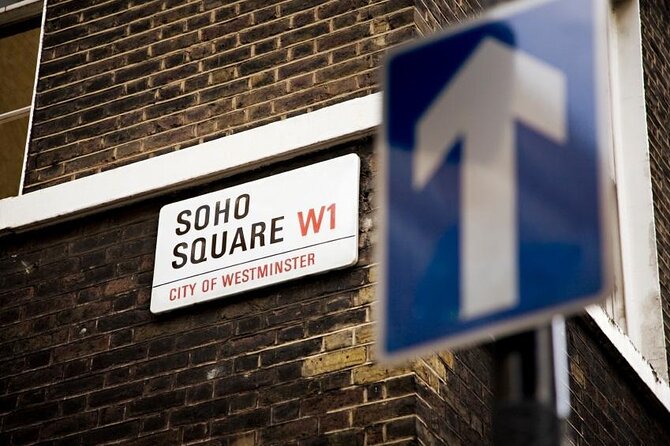
- Soho’s gang map: stops linked to courts, clubs, and famous street addresses
- Carnaby Street fashion and crime side-by-side: 1960s and 1970s culture shows up in the stories
- Names you’ll recognize: from the Krays to British rock pioneers tied to Soho venues
- Ends near major Tube stations: an easy exit at the finish on Greek Street
Soho’s gangsters: what you actually learn on the pavement
This tour is built for people who love true crime, but also for people who like understanding how neighborhoods change. Soho gets described as nightlife first, but here you’ll see it as an operating system: venues, door policies, court cases, and power networks all connected to specific corners.
What makes it work is the structure. You’re not stuck with a lecture. You’re walking from one named location to the next—London Palladium, Carnaby Street, Wardour Street, Greek Street—and the guide keeps those places tied to characters and events rather than vague atmosphere. I found that stop-to-stop approach helps you remember more than if you just hear names in the abstract.
The tour also leans into the 1960s and 1970s, when Soho was a magnet for music, fashion, and trouble. You’ll hear how the same streets that hosted parties also produced fights, policing problems, and drug cases—basically, the fun and the friction lived close together.
You can also read our reviews of more tours and experiences in London.



Meeting at ICE on Oxford Street, ending on Greek Street
You’ll meet at ICE – International Currency Exchange, 241 Oxford St (W1D 2LT). It’s an easy landmark for central London, and once you’re there you’ll be ready to start quickly without hunting for a “meeting point” pin.
The tour finishes at 58 Greek St (W1D). The good news is you’re not stranded after the last story. From Greek Street, it’s about a five-minute walk to either Tottenham Court Rd (Central/Northern/Elizabeth lines) or Leicester Square (Piccadilly/Northern lines). That matters because London nights can turn into a waiting game if you end far from transit.
Also, the tour uses a mobile ticket, and it’s capped at 25 travelers. A smallish group is one of the biggest practical wins for this kind of guided story walk, because you get better hearing and the guide can keep everyone moving without turning it into a stop-and-go shuffle.
Stop-by-stop: London Palladium, courts, and Carnaby Street’s power players
1) London Palladium: Brian Epstein’s plaque and Sunday-night glamour
Your first stop is outside the London Palladium, a theatre that was famous in the 1960s and 1970s for Sunday Night at the London Palladium. Standing nearby is a quick history reset for the whole area—because Soho’s nightlife energy didn’t stay in bars. It moved right into major venues.
You’ll also look at the plaque to Brian Epstein, manager of the Beatles. That single detail helps explain why Soho mattered to music culture, not only crime. The guide uses this kind of connection a lot: entertainment, reputation, and money all tied together.
2) Courthouse Hotel: the Magistrates court angle
Next you move to the Courthouse Hotel area, once Great Marlborough St’s Magistrates court. The key idea here is that Soho’s problems weren’t just street-level. People ended up in court—especially for drug charges and other offences.
This stop gives the tour a grounding. When you learn names and stories, it helps to understand the legal side too. Courts were where power showed up in formal form, and the guide uses the building context to make that feel real.



3) Carnaby Street: gangsters from the 1920s up through the swinging years
Entering Carnaby Street, the tour shifts into a broader gangster timeline. You’ll hear about gangsters connected to Soho over the years, including Darby Sabini, Billy Kimber (linked to Peaky Blinders), Billy Hill, Jack ‘Spot’ Comer, and the Messina Bros.
Even though the tour focuses on the 1960s and 1970s, this backfill is useful. It shows that the later Soho scene wasn’t invented overnight. The same neighborhood kept producing new waves—new faces, new venues, and new ways to control attention.
4) 50 Carnaby St: clubs that changed with the decades
At 50 Carnaby St, you’ll hear that many clubs stood on that spot from the 1930s until the 1970s. The guide’s point is simple: Soho addresses weren’t static. Venues evolved, ownership changed, and the power players moved with the rooms.
This is a good moment to look up at the façades. Even when a storefront looks totally modern, the guide’s narration helps you imagine older layouts and older crowds.
5) Spirit of Soho mural: famous residents from Casanova to Jeffery Bernard
Then you’ll pause at the Spirit of Soho Mural, where the story stretches beyond gangsters. The mural shows notable and infamous figures who lived in Soho, including Casanova and Mozart, plus George Melly, Jeffery Bernard, Brendan Behan, and Johnnie Dankworth.
This stop widens the lens. Not every Soho character fits a police file, but the neighborhood still becomes a social magnet. If you like culture and crime interlocking, this is one of the most interesting switches in the route.
6) John Snow replica pump: cholera mystery in 1854
At John Snow, you’ll stop at a replica pump outside the pub named after him. John Snow is recognized as the first British epidemiologist who solved the mystery of a cholera outbreak in 1854 that had already killed 500 people.
It sounds like a curveball compared to gangsters—and that’s exactly why it works. Soho wasn’t only about nightlife violence. Public health and disaster-shaped decision-making were part of the city too. The guide uses the marker to remind you that London’s “secrets” aren’t always criminal.
7) Walker’s Court: Paul Raymond, strip history, and men’s magazines
Walker’s Court is where the tour turns toward the business side of Soho nightlife. The stop looks at the site of Raymond’s Revue Bar, described as the first place in Soho where strippers could move once naked. You’ll also hear that Paul Raymond published men’s magazines (including Men Only and titles noted with Mayfair) and was a property magnate worth £650 million.
I like this stop because it explains why Soho could support risky entertainment in the first place. It’s not just about “bad guys.” It’s also about entrepreneurs building systems—venues, publicity, and money—inside a tight urban footprint.
8) Wardour Street: the Flamingo Club and rock-pop glamour
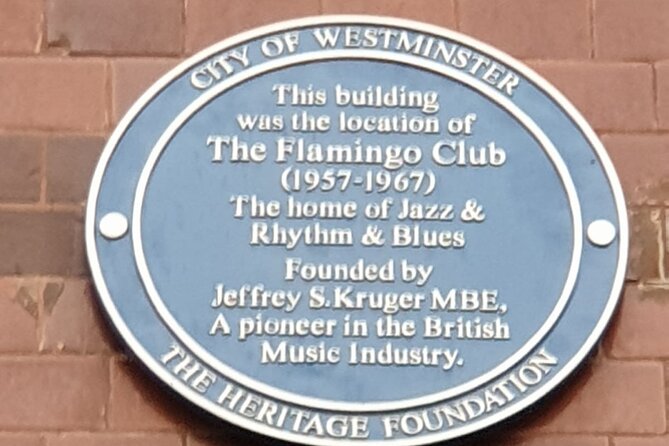
On Wardour Street, you’ll learn about the Flamingo Club, where a who’s who of British and American rock and pop stars flocked in the 1960s and 1970s.
If you want context for why gangs could thrive near music scenes, this is a strong stop. Fame creates foot traffic. Foot traffic creates opportunities. And when the crowd changes, the trouble moves to match.
Wardour to Greek Street: Krays, club addresses, and police corruption
9) Gerrard Street: Boulogne Restaurant to the El Morocco clubs
On Gerrard Street, the guide traces a long thread of Soho nightlife and gangster ownership. You’ll hear about the Boulogne Restaurant, a hostess club at the Wardour St end, and then move to no. 15, where the Kray twins opened their El Morocco club after their first central London club, Esmeralder’s Barn in Kensington.
You’ll also hear about Kate Merricks, linked with the 43 Club at number 43. The overall effect is a “follow the addresses” lesson: Soho’s crime stories aren’t only legends—they have street addresses and venue names.
10) The French House: the Krays’ relationship with Lord Boothby
Opposite The French House, the tour discusses the Kray twins and their relationship with Lord Boothby. This is where the guide connects club power with social power.
It’s an important angle because it helps you understand why certain people could keep operating. In London, class lines and social circles can matter as much as who throws the punch.
11) 2i’s Coffee Bar: the birthplace of British rock and a route to future stars
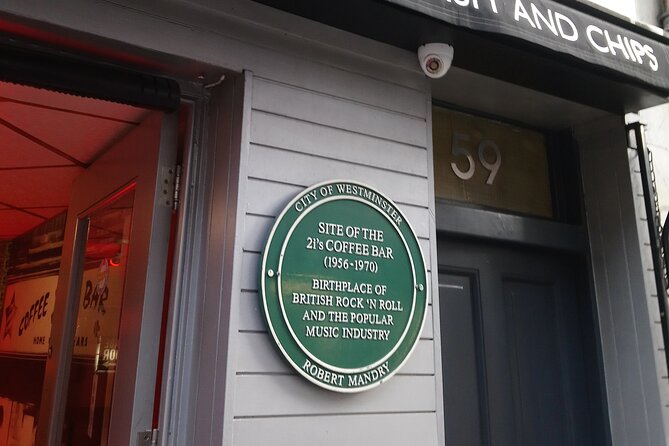
Next is Green Plaque: 2i’s Coffee Bar, presented as the birthplace of British Rock & Roll. You’ll hear it was run by a wrestler called Dr Death, and that future stars were discovered from 1960 onward, including Tommy Steel, Cliff Richard and the Shadows, and Screaming Lord Sutch.
Today it’s a fish and chip restaurant, Poppies. That’s a great moment to notice how the city reuses its spaces. The same corner that once pulled in rock acts can now feed you chips. London rarely deletes its past—it edits it.
12) Frith Street: Ronnie Scott’s Club still there
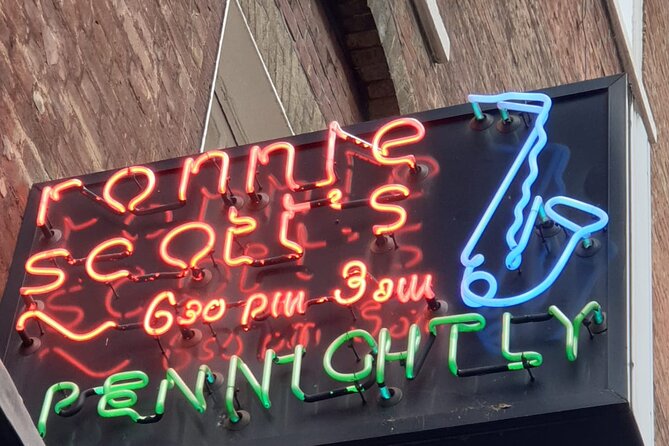
On Frith Street, you’ll look down and see Ronnie Scott’s Club, still operating today. The great man and his wife, Cleo Laine, are sadly now gone.
Even if you’re not a jazz specialist, this stop is handy. It anchors the tour in something ongoing, so Soho doesn’t feel like a museum under glass. It feels like a living neighborhood with an older pulse underneath.
13) Greek Street corner: the Krays and multiple murder stories
At the corner with Old Compton St on Greek Street, you’ll hear more Kray coverage and several murder stories, including the murder of Jack the Hat and the Mad Axman (Frank Mitchell), plus Freddie Foreman, Ronnie Knight (Barbara Windsor’s first husband), and the murder of Alfredo Zomperelli.
This is the tour’s most intense storytelling segment, and the guide keeps it tied to place. If you’re sensitive to violent content, this is where you may want to pace yourself and step back mentally as you listen.
14) 58 Greek St: police corruption—Bernie Silvers, door-flat power, and Scotland Yard links
The final stop at 58 Greek St shifts toward police corruption in the 1960s and 1970s. You’ll hear about Bernie Silvers and Frank Mifsud, said to run most of the doorbell flats. You’ll also hear about Commander Drury of Scotland Yard and his relationship with publicity baron Jimmy Humpheries and Jimmy’s wife Rusty Gaynor.
This ending is more than a doom note. It’s the guide’s argument about how Soho’s underworld could operate: enforcement wasn’t always clean, and the boundaries between legitimate power and street power could blur.
When the tour ends here, you’re also close to major transit, which makes it easier to keep your night moving without feeling stuck at the edge of nowhere.
Why this walking route feels so real (and not just edgy)
A gangster tour can go two ways: spooky storytelling with no grounding, or stories tied to real rooms, doorways, and street rules. This one leans toward the grounded side.
I especially like how the guide uses well-known London “anchors” (the London Palladium, Carnaby Street, Wardour Street) and then layers in the less famous details. That combination helps you understand Soho as a system where culture and crime kept crossing paths.
And you get practical learning you can use later. After walking these streets, you’ll be better at reading London as you travel—spotting how a venue’s location, ownership patterns, and nearby transport routes shape what happens in a neighborhood. Soho is one of the most extreme examples, which is exactly why the tour works.
Practical tips: how to get the most from a 2-hour Soho walk
This is a walking-heavy tour on central streets, with multiple short stops. Plan to wear comfortable shoes, because the route includes quick repositioning between corners.
Since the tour doesn’t include coffee, tea, water, snacks, or alcohol, I’d treat it like any city walk: bring what you need. If you’re going in warm months, get water before you start at Oxford Street.
Because it requires good weather, bring a light layer even when London looks calm. A drizzle can make street walking less fun fast, especially when you’re standing around outside buildings for narration.
Also, it’s capped at 25 travelers, so it usually stays manageable. Still, if you know you hate crowds, go early in the day and arrive a few minutes before the meeting time so you’re not stressed at the start.
Who should book this Gangster Tour of Soho?

Book it if you like:
- true crime told through real locations, not just theory
- the London side of police dramas and crime histories
- music and fashion context (Carnaby Street, rock venues, 2i’s Coffee Bar)
Consider skipping it if:
- you don’t want violence or murder stories in the narration
- you’re traveling with anyone under 18 (it’s listed as unsuitable)
- you want a relaxed “just wander and see sights” outing with no darker subject matter
This tour also makes a great pair with a later evening in Soho. Even though the tour itself covers the key spots, the area around the route gives you plenty of options to keep the theme going after the walk.
Should you book? My take on value and fit
If you’re a fan of Soho—its music, fashion, and darker side—this is a strong buy. With a listed price of $0.00, the value is hard to beat, and the route hits landmarks you’ll recognize even if you’ve never chased true-crime content in London before.
You should book it if you want a structured way to learn Soho in two hours. This isn’t a “wander and hope” tour. It’s a named-stop walk with a clear storyline: street gangs, clubs, courts, and the ways power shaped what happened on these corners.
If you’re more into polished museum-style history, you might find the tone heavy during the murder and police corruption segments. But if you can handle that, you’ll leave with Soho mapped in your head—and with a much better sense of why this neighborhood keeps showing up in crime stories.
FAQ
How long is the Gangster Tour of Soho?
It runs for about 2 hours.
Where does the tour start?
The tour starts at ICE – International Currency Exchange, 241 Oxford St, London W1D 2LT.
Where does it end?
It ends at 58 Greek St, London W1D.
Is there a mobile ticket?
Yes, it uses a mobile ticket.
How many people are in a group?
The tour has a maximum of 25 travelers.
Is it suitable for kids or teens?
No. It’s listed as unsuitable for under 18s.
What’s included besides the guided walk?
You get a walking tour of Soho with places to visit after the tour, including shops, restaurants, and bars in the area.
What’s not included?
It doesn’t include alcoholic beverages, coffee or tea, bottled water, or snacks.
What if the weather is bad?
The tour requires good weather. If it’s canceled due to poor weather, you’ll be offered a different date or a full refund. You can also cancel for a full refund up to 24 hours in advance.
How do I get back to the Tube after the tour ends?
From Greek Street, it’s about a 5-minute walk to Tottenham Court Rd (Central/Northern/Elizabeth lines) or Leicester Square (Piccadilly/Northern lines).