REVIEW · LONDON
London: British Museum Private Guided Tour
Book on GetYourGuide →Operated by Iconic London Taxi Tours · Bookable on GetYourGuide
A museum this big can make your brain go fuzzy. This private British Museum tour keeps you focused on the most important objects and the stories behind them. You’ll move through human history fast, but with a guide to keep the timeline straight and the symbolism explained.
I especially like that the guide makes it easy to ask questions. You also get real value from seeing big-ticket highlights like the Rosetta Stone and the Parthenon Marbles without spending hours wandering and second-guessing what matters.
The main drawback to consider is simple: 2 hours is short compared with an 8-million-object collection. You’ll leave wanting more, not feeling like you’ve seen it all.
In This Review
- Key points to know before you go
- Two million years, eight million objects: how this tour avoids overwhelm
- Getting there: Edward VII entrance at Montague Place (and what to expect on arrival)
- The Rosetta Stone: why the guide matters for this one object
- Parthenon Marbles and the Easter Island statue: seeing the world in unexpected pairs
- Lewis Chessmen and Sutton Hoo: when entertainment turns into history lessons
- Great Court and the museum’s bigger story: how empire shaped the collection
- How the route keeps you from getting stuck in museum label land
- Private-group timing: what “exclusive access” feels like in practice
- Practicalities that make or break a museum tour
- Price and value: is $263 per group up to 8 a smart deal?
- Who this tour is best for (and who might want a different plan)
- Should you book this British Museum private tour?
- FAQ
- What time does the tour start?
- Where is the meeting point?
- How will I find the guide at the meeting point?
- What is included in the tour?
- What is the tour duration?
- Is the tour private?
- What languages is the tour in?
- Is the tour wheelchair accessible?
- Are there any rules about photos or bags?
- What should I bring?
Key points to know before you go
- Private, small group time with a guide who can answer your questions as you go
- Big-name highlights included, like the Rosetta Stone, Parthenon Marbles, and Great Court
- Museum history through empire and discovery, not just a list of artifacts
- A cross-regional timeline from Ancient Egypt to the Vikings in a single focused route
- Practical rules (no large bags, no flash) that keep the tour smooth
Two million years, eight million objects: how this tour avoids overwhelm
The British Museum is enormous. The collection spans two million years and sits across objects from multiple continents, all packed into one place. With up to 6 million visitors a year, it can feel like you’re fighting the crowd just to read a label.
That’s exactly why a private guide helps. In two hours, you’re not trying to “cover” the museum. Instead, you’re getting a guided path through the highlights and the key connections between them, so your visit feels coherent instead of chaotic.
Also, the Great Museum problem is attention. You might know a few famous names, but your brain needs context to make them meaningful. This tour is built to give you that context, especially around how the museum formed its collection and what those objects represent today.
You can also read our reviews of more guided tours in London



Getting there: Edward VII entrance at Montague Place (and what to expect on arrival)
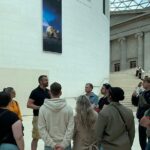
You’ll meet at the rear entrance by the Edward VII entrance on Montague Place. The guide contacts you by WhatsApp/message with location details so you can match the guide to the right spot.
This matters more than it sounds. If you arrive ready to go, you lose less time figuring out entrances and navigating the building. And since this is a private tour, you don’t want your group stuck waiting outside while others drift past.
One more practical point: the tour rules keep things moving. No luggage or large bags, and no back packs. Bring what you can comfortably carry, and wear shoes that can handle a lot of standing.
The Rosetta Stone: why the guide matters for this one object
The Rosetta Stone is the kind of artifact that many people feel they already know. It’s famous, it’s photographed, and it’s often talked about like a magic decoder ring.
What’s more useful on a guided visit is the “why.” You’ll learn why the Rosetta Stone is described as the key to deciphering ancient Egyptian hieroglyphs, and you’ll get help connecting it to the broader story of Egypt in the museum. Without that explanation, you can stare at the stone and still feel stuck at the surface level.
On a highlights tour, you’ll also see the Rosetta Stone in the context of other Egyptian-related materials. That “grouping” effect is where the value shows up. The museum becomes more than a list of famous objects.
And because this is private, it’s easier to ask follow-up questions if you want more detail on how translations work or how the museum frames interpretation.
Parthenon Marbles and the Easter Island statue: seeing the world in unexpected pairs
One of the smartest parts of this tour is how it mixes regions instead of staying in one lane. You’ll see the Parthenon Marbles and also the Easter Island statue (Hoa Hakananai’a), two objects that come from very different places and histories.
That contrast helps you notice something important. Museums don’t just display artifacts. They also shape how you think about distance, culture, and meaning across time.
With the Parthenon Marbles, you’ll get the basic anchor: they’re sculptures from Ancient Greece. But a good guided route adds the missing layer—how Greek art fits into the museum’s larger sweep, and why these works became central to how the public understands classical history.
Then you shift to Hoa Hakananai’a, described as a mysterious relic from the remote Pacific. The word mysterious is doing real work here. It signals that not everything about remote cultures is instantly readable through our modern expectations. A guide can point out what you can interpret, what remains uncertain, and how museums handle that gap.
If you’re the type who likes to compare different cultures side-by-side, this pairing is a win. You’ll start seeing the museum as a conversation, not just a warehouse.
Lewis Chessmen and Sutton Hoo: when entertainment turns into history lessons
The tour includes two objects that, at first glance, feel almost playful: the Lewis Chessmen. They’re intricately carved Viking-era chess pieces from the 12th century, and they don’t look like “serious history” until you understand what they represent.
A guide helps you reframe them. Chess isn’t just a game; it’s a window into leisure, skill, and shared cultural practice. On this tour, you don’t just look at carvings. You learn why these pieces belong in the larger Vikings story the museum tells.
Then you’ll move to something dramatically different: the Sutton Hoo ship burial. You’ll see it described as an Anglo-Saxon royal treasure hoard. This is where the museum’s range becomes obvious. One stop is carved detail you can almost hold in your imagination as a personal item. The next stop is about power, ritual, and the politics of memory.
The value here is in the transition. When the route goes from Viking chess pieces to a royal burial treasure, you learn that “daily life” and “political life” are both part of the same historical picture.
And because this is a highlight tour, you may also catch related themes along the way—like mummies, ancient coins, priceless armor, and architectural wonders—without getting lost in the museum’s sheer volume.
You can also read our reviews of more private tours in London






Great Court and the museum’s bigger story: how empire shaped the collection
The Great Court is a headline feature, and it lives up to its billing as the largest covered square in Europe. This is one of those museum spaces that you feel in your body. You look up, you take in the scale, and suddenly the building stops being background and becomes part of the experience.
But the tour doesn’t only focus on architecture. You’ll learn about the museum’s history and the role of the British Empire in shaping the collection. That’s a big topic, and it can go two ways in a tour: either it’s avoided or it’s simplified.
Here, the focus is on the connection between how objects were acquired, how discoveries were made, and how the museum turned those materials into a public collection spanning many continents. The stories around discovery—whether through exploration, tomb raiding, or the spoils of war—are part of what the guide uses to connect artifacts to human behavior.
This is worth paying attention to if you care about more than aesthetics. It helps you understand that museum displays come with framing. Even when an object is astonishing, the story behind it affects how we interpret it now.
You also get time in the space that functions like a hub. That makes it easier to orient yourself and decide what you want to see next on your own.
How the route keeps you from getting stuck in museum label land
A common problem with self-guided museum visits is that you spend time reading labels that don’t answer your questions. Or you zoom past key objects because you’re unsure where the “important stuff” really is.
A guided highlights route solves this by giving you a narrative order. You’re not just seeing what’s famous; you’re seeing how those famous objects connect to eras like Ancient Egypt, Rome, the Saxons, and the Vikings.
That still leaves you a choice in how you experience it. If you want quick visual impact, the highlights deliver. If you want meaning, the guide’s explanations help you slow down at the right moments.
You’ll also get personalized recommendations at the end. That part is underrated. Most people leave museums and forget what they meant to look for next. A guide’s suggestions help you convert your time into a follow-up plan.
Private-group timing: what “exclusive access” feels like in practice
The tour is designed for a private group of up to 8 people. That size is big enough to travel comfortably together, but small enough to keep movement smooth and conversations possible.
Because the museum has huge visitor numbers, private timing can feel like a pressure valve. Instead of getting swept along with the crowd, you get a guide pacing your route so your group isn’t constantly pausing for people to pass.
Also, private access makes it easier to slow down when something catches your eye. If you want to ask one more question about how an object was used, or why it’s interpreted a certain way, you can do it without worrying that everyone else is being delayed.
Practicalities that make or break a museum tour
Comfort matters here. The tour lasts 2 hours, and you’ll be on your feet. Bring comfortable shoes and wear clothing that lets you stand and walk without thinking about it.
For rules, keep it simple:
- No flash photography
- No luggage or large bags
- No back packs
You’ll also want to keep your essentials minimal so you’re not juggling items while moving between rooms. Museum visits go smoother when you don’t feel like you’re managing your belongings more than your itinerary.
If you care about accessibility, the tour is listed as wheelchair accessible. That’s a strong plus for people who want a guided museum experience without feeling shut out.
Price and value: is $263 per group up to 8 a smart deal?
At $263 per group up to 8, the value depends on your group size and your goals.
If you’re traveling as a small family or a couple of friends, you’re essentially paying for a guided route that focuses your time on the museum’s best-known objects. In that case, the cost often feels reasonable because you’re not just buying “someone to talk.” You’re buying time saved and a structure that helps you understand what you’re seeing.
The tour also includes not only landmark objects like the Rosetta Stone, Parthenon Marbles, and Great Court, but also thematic storytelling about the museum’s origins and how the British Empire affected its collection. That kind of contextual help can make your photos and your memories more meaningful.
If you’re going alone, the same price can feel steep compared to a public audio guide. But if you know you’ll ask questions, or you want help picking what to do next afterward, it can still be worth it.
The simplest way to judge the price is this: if you want a guided “best of” route with expert explanations in a short window, you’re paying to avoid decision fatigue.
Who this tour is best for (and who might want a different plan)
This private tour is ideal if you:
- Want to see major highlights in 2 hours without getting lost
- Prefer a guide who can answer questions as they come up
- Like museums when they’re explained as stories, not just displayed objects
- Have limited time in London but still want meaningful context
You might consider a different plan if you:
- Want to wander deeply room-by-room for hours
- Plan to carry lots of bags or need to bring bulky items (the tour restricts large bags/backpacks)
For most people, it hits a sweet spot: focused, efficient, and built around the objects that act like anchors in the British Museum’s long timeline.
Should you book this British Museum private tour?
I’d book it if you’re short on time and you want more than name recognition. The mix of Rosetta Stone, Parthenon Marbles, Hoa Hakananai’a, Lewis Chessmen, and Sutton Hoo gives you a fast tour through major themes, and the guide’s focus on how the collection formed helps you read the museum more intelligently.
Also, the small private group size and the guide’s openness to questions makes it feel personal rather than scripted. You’ll leave with a clearer sense of what you want to explore next.
If you’re planning to go anyway and you want a tailored starting point, this is a strong use of your first museum visit time. If you’d rather have total freedom for hours, then you might enjoy self-guided wandering more. But if your goal is to get oriented fast and understand the big objects, this tour does that job well.
FAQ
What time does the tour start?
The tour runs for 2 hours, and starting times vary. You can check availability for specific times.
Where is the meeting point?
Meet at the rear entrance by the Edward VII entrance on Montague Place, London.
How will I find the guide at the meeting point?
The guide will contact you via WhatsApp/message with location and a description to help you identify them.
What is included in the tour?
A private expert guide, exclusive access, and a highlights tour. You’ll view major objects such as the Rosetta Stone, Easter Island statue, Parthenon Marbles, Lewis Chessmen, Sutton Hoo ship burial, and more.
What is the tour duration?
The tour lasts 2 hours.
Is the tour private?
Yes. It’s a private group experience for up to 8 people.
What languages is the tour in?
The tour is in English.
Is the tour wheelchair accessible?
Yes, the tour is listed as wheelchair accessible.
Are there any rules about photos or bags?
Flash photography is not allowed. Luggage or large bags and back packs are also not allowed.
What should I bring?
Wear comfortable shoes. Food and drink and guide books are not included.