REVIEW · LONDON
London: Natural History Museum Private Tour & Skip the line
Book on GetYourGuide →Operated by DS Tours London · Bookable on GetYourGuide
Dino dreams, no queue. A 2-hour private tour of the Natural History Museum lets you enter fast with skip-the-line access, then see the big, unforgettable exhibits without the stress of wandering. You also get a guide to help you focus on what’s actually worth your time inside.
My favorite part is the mix of classic “wow” with real interaction. You’ll spend time at the earthquake simulator and join in with physics experiments, so the museum feels less like a hallway of glass cases and more like learning you can do.
One thing to note up front: unaccompanied minors aren’t allowed, so plan adult supervision for younger kids.
In This Review
- Key highlights worth your time
- Skip-the-line at South Kensington: start where you should
- The guided dinosaur and fossil route that actually works
- Earthquakes and volcanoes: hands-on science, not just facts
- Physics experiments (and why they’re a smart fit for this tour)
- The museum mascots: Hope the blue whale and Sophie the stegosaurus
- The quieter stops: Blue Marlin, giraffes, and a 1500-year-old sequoia
- How the private guide changes your pace (Damiano and Stefania)
- Price and value: $168 per group up to 3 people
- What to expect on the ground: timing, walking, and photography
- Who this tour is best for
- Should you book this Natural History Museum private tour?
- FAQ
- How long is the Natural History Museum private tour?
- What group size is this tour for?
- Do I get skip-the-line entry?
- What languages are the guides available in?
- What’s included during the tour?
- What will I see during the visit?
- Is photography allowed?
- Is the tour suitable for people with mobility needs?
- What do you need to bring, and what isn’t allowed?
- Can I cancel and get a refund?
Key highlights worth your time
- Skip-the-line entry through a separate entrance so you start strong instead of waiting around
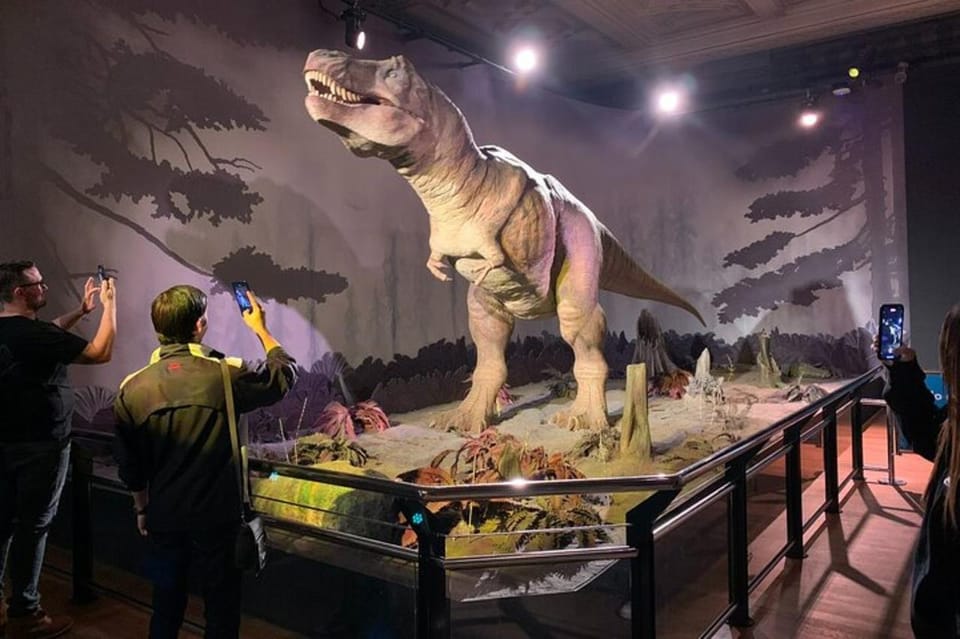
- Dinosaurs and fossils built into a guided path, including major specimens like Megatherium and Ichthyosaur
- Earthquake simulator plus learning about how volcanoes are born
- Hands-on physics experiments that work especially well for kids and curious adults
- Hope (blue whale) and Sophie (stegosaurus) as museum mascot skeletons you’ll see close up
- A 1500-year-old sequoia section for a change of pace from animals and rocks
Skip-the-line at South Kensington: start where you should
This tour starts at South Kensington Museums (Stop L). From there, you head to the Natural History Museum, and the whole point is getting you in without the usual bottleneck. The separate entrance matters because the Natural History Museum can feel crowded fast, especially around the main galleries.
Once you’re inside, you get a private guide and a clear plan for the 2 hours. That’s the practical advantage: you’re not spending precious time deciding where to go next. You’re also not stuck in a big group that moves when everyone else moves. With a private setup, you can slow down where something grabs your attention—like a fossil detail you wouldn’t notice on a quick self-guided visit.
The meeting point itself is simple if you’re already in the South Kensington museum area: the bus stop is between the Victoria & Albert Museum and the Natural History Museum at Exhibition Road, very close to the traffic lights.
You can also read our reviews of more private tours in London


The guided dinosaur and fossil route that actually works
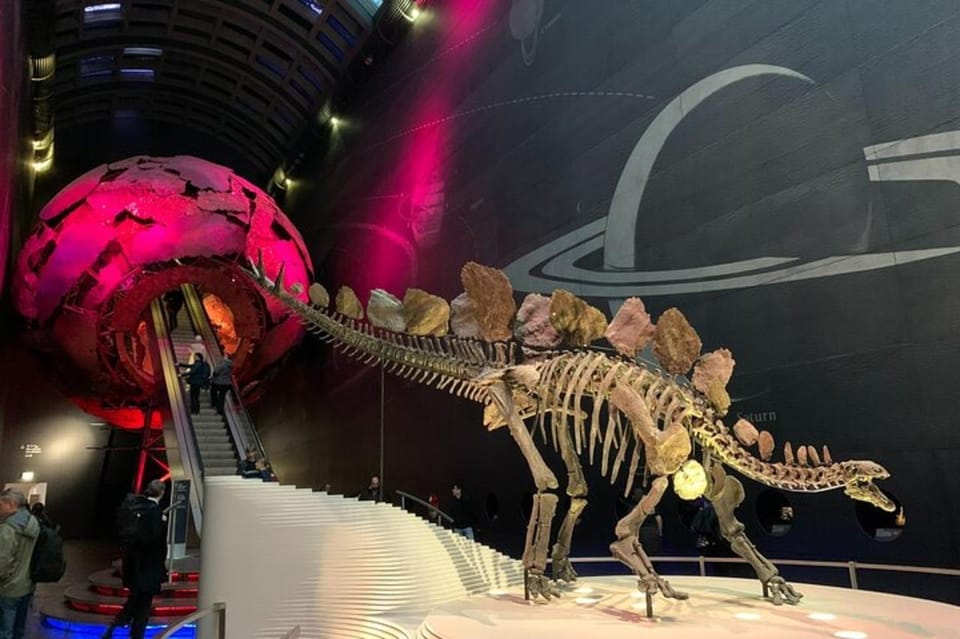
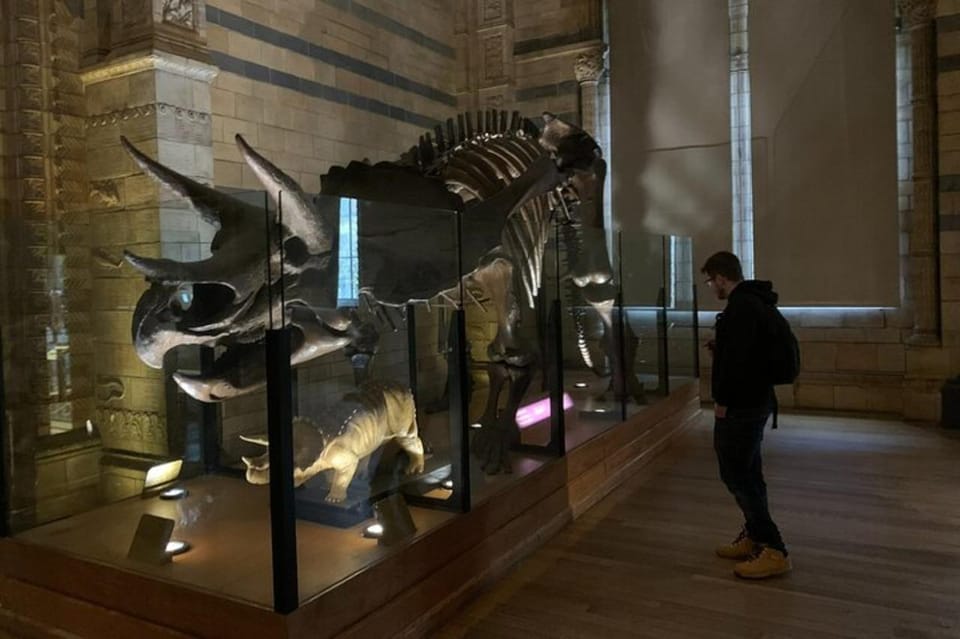
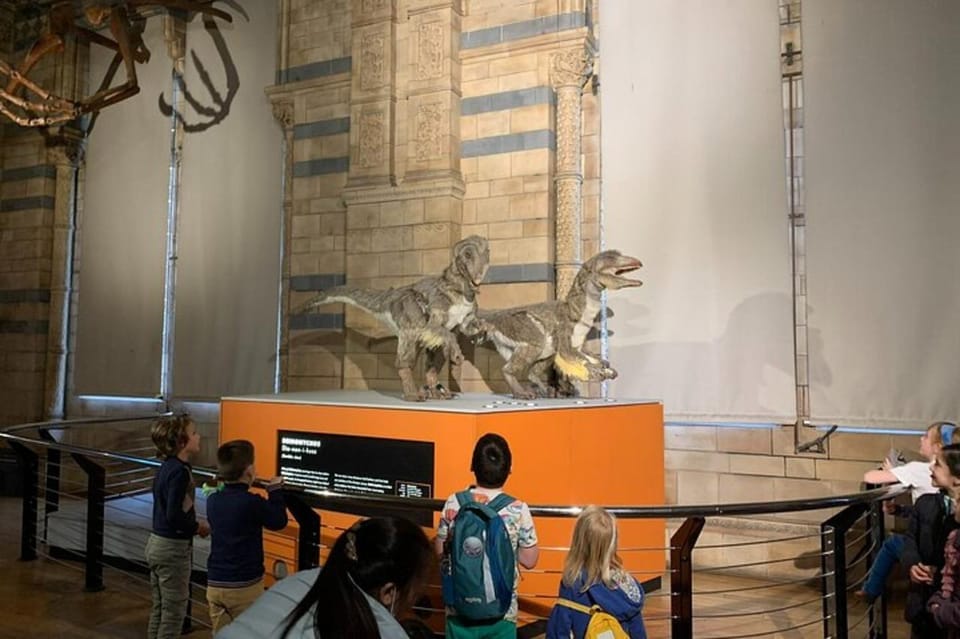
The Natural History Museum’s brand is dinosaurs, and for good reason. This tour is designed around that core, but it’s not just a generic parade past the biggest skeletons. Your guide helps you hit key exhibits and teaches you how to look at them.
You’ll see major fossil and specimen highlights, including:
- Megatherium
- Ichthyosaur
- Mastodon
- Mantellisaurus
- and other famous exhibits such as a Blue Marlin display and giraffes
That list is useful because it spans different kinds of museum storytelling. You’re not only seeing big bones—you’re getting a sense of what the fossil record can tell you (and what it can’t). A guide also helps you understand scale, features, and what makes each animal distinct, which is where a lot of self-guided visits fall flat.
One more smart detail: you’ll be shown where to stand and how to view key pieces. That sounds small, but it changes everything. Some skeletons and fossils are easy to miss at the right angle, and the guide makes sure you don’t waste time hunting for the best viewpoint.
If you want a benchmark for how guides can change the experience, I’d pay attention to the names that come up in feedback. Damiano, for example, is repeatedly praised for working well with a ten-year-old and for pointing out the exact highlights and viewing spots. That’s the difference between seeing a museum and getting the museum to make sense.
Earthquakes and volcanoes: hands-on science, not just facts
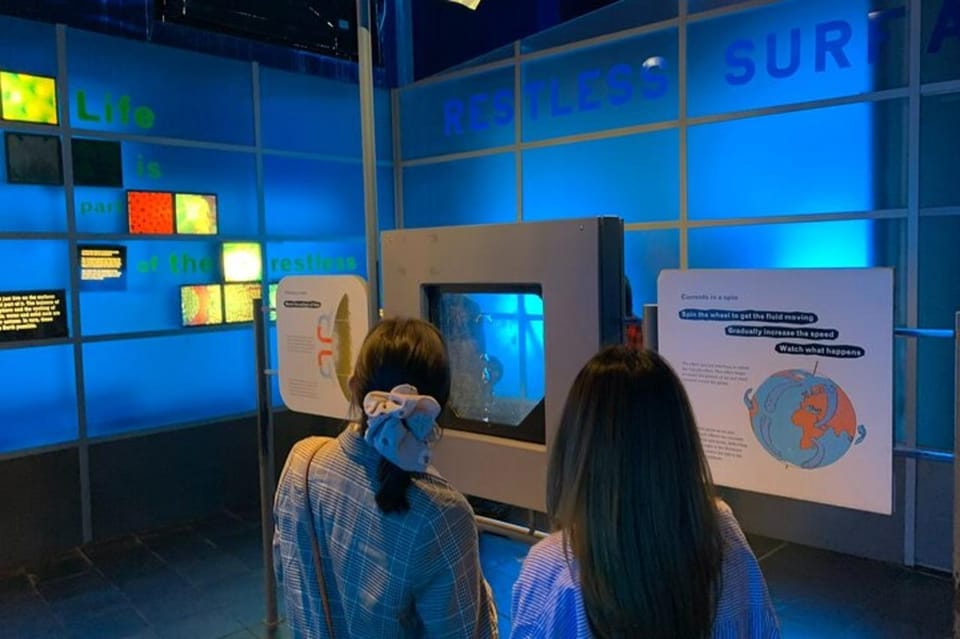
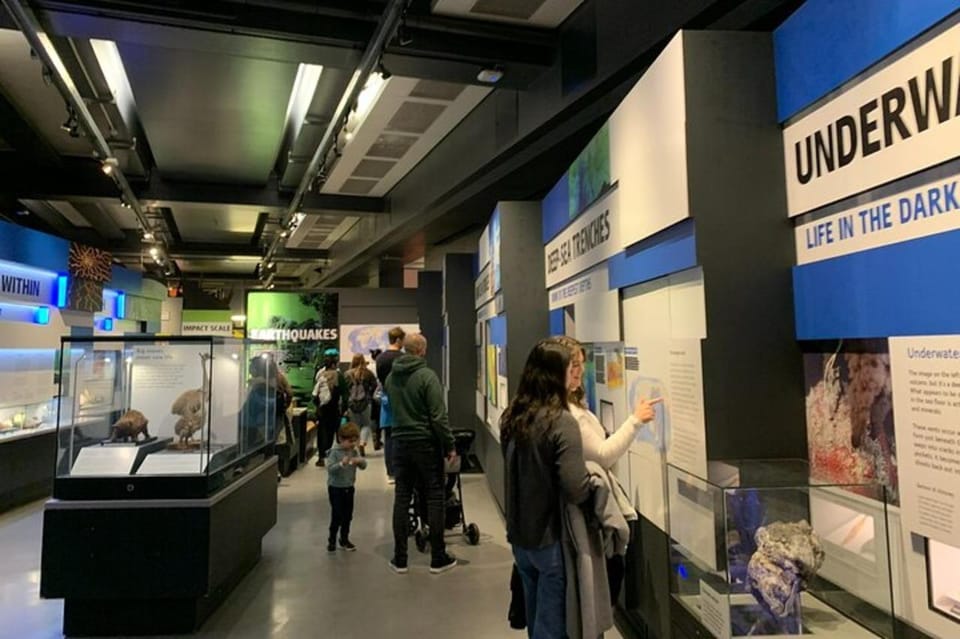
A huge reason this tour feels different from a standard museum walk is that it includes interactive learning. One of the most memorable stops is the earthquake simulator, where you get to experience how shaking works rather than only reading about it.
You also learn about the birth of volcanoes. The museum doesn’t treat geology like background noise; it treats it like an explanation for the planet you’re standing on. When you pair that with the earthquake simulator, the story becomes physical. You can connect rocks, forces, and effects in a way that sticks longer.
For kids, this is often the moment the whole visit clicks. For adults, it’s a good reminder that museums can teach without being lecture-heavy. Either way, it’s a strong use of your 2-hour time budget, because it’s both educational and genuinely fun.
Physics experiments (and why they’re a smart fit for this tour)
After the geology-themed time, you’ll get to play with physics experiments. These aren’t “just for kids” activities. The value here is that they break up the museum’s visual density. Museums like this can start to blur together—especially when you’re looking at bones, rocks, and display text all at once.
The experiments give you a reset. Your brain switches from reading mode to doing mode. That means you come back to the next gallery with more energy, and you remember more.
And because this is a private tour, you’re not competing for attention with a dozen people. If your group has different interests—dinosaurs for one person, geology for another—your guide can flex inside the tour structure.
The museum mascots: Hope the blue whale and Sophie the stegosaurus
At some point, every Natural History Museum visit should hit the skeletons that people associate with the place. This tour takes you to:
- Hope, the blue whale skeleton
- Sophie, the stegosaurus skeleton
These two are great for a simple reason: they’re emotional anchors. You walk in, and suddenly the museum feels friendly. You also get to compare creature designs across huge time scales—marine mammal, dinosaur, and everything between.
For kids, it’s often the “aha” moment when the museum turns from a list of exhibits into characters. For adults, it’s a chance to slow down and appreciate the science behind what you’re seeing: the arrangement of bones, how they’re interpreted, and why those shapes matter.
You can also read our reviews of more historical tours in London


The quieter stops: Blue Marlin, giraffes, and a 1500-year-old sequoia
Not every highlight has to be the loudest one. This tour also includes a few excellent “change of pace” exhibits.
You’ll see the Blue Marlin and giraffes—the kind of displays that add variety beyond the dinosaur-and-fossil focus. If your group includes mixed ages, these are usually the moments where everyone finds something they can enjoy without needing to be a specialist.
Then there’s the Sequoia section. You’ll get to see a part of a sequoia dating back more than 1500 years. That’s a clever contrast: after time spent thinking about animals from deep time, you switch to a living connection to the present. It makes the museum feel less like a single theme park and more like an explanation of the natural world as a whole.
How the private guide changes your pace (Damiano and Stefania)
The guide is the real engine of this experience. You’re not just paying for entry—you’re paying for interpretation, routing, and attention to your group.
In the feedback, Damiano is repeatedly described as fantastic with kids—informative, playful, and focused on exactly what to see. Stefania is praised as especially great, with the kind of energy that makes a family visit feel smooth instead of chaotic.
Even if you already know your way around museums, a guide helps you avoid two common mistakes:
1) Spending time on the wrong exhibit because it’s nearby, not because it’s essential
2) Missing the “why” behind what you’re looking at
For a 2-hour visit, those mistakes cost you.
Price and value: $168 per group up to 3 people
At $168 per group up to 3, this tour can be a strong deal if you value a guided plan plus hands-on activities. The math is simple: if you fill all three spots, the effective cost per person drops significantly compared to booking solo.
Where the value really comes from is that the tour isn’t only about seeing famous skeletons. You also get:
- skip-the-line entry
- a private guide
- the earthquake simulator experience
- included interactive experiments
So you’re paying for time saved, attention, and activities that you may not naturally seek out on a self-guided visit. If you and your group are the type who likes guided context—especially with kids—this price makes more sense.
If you’re traveling solo and you’re happy with a self-guided route, you might decide it’s not necessary. But if you’re optimizing time and want the hands-on stops, it’s easier to feel that you’re getting what you paid for.
What to expect on the ground: timing, walking, and photography
The tour runs for 2 hours. That’s enough time to hit major themes—dinosaurs/fossils, geology interactions, and the mascot skeletons—without dragging on. It also means you’ll want to wear comfortable shoes. You’ll be walking within a museum complex, and it’s not the kind of tour where you can just stop whenever you want for long stretches.
Photography is allowed, which is great because the museum has a lot of photo-friendly moments: big skeletons, fossil displays, and the dramatic contrast between animals and geology. Just keep an eye out for any areas where the guide directs you to stand in specific spots for viewing.
Who this tour is best for
This is a smart choice if:
- you’re visiting with children who will likely enjoy the simulator and experiments
- you want a museum visit that feels structured, not scattered
- you’re short on time and want a guide to prioritize the most important stops
- you want a private experience with a guide who can adapt to your group’s pace
It also works well for couples. If you’re both into animals and science, the tour gives you enough variety that you don’t end up hearing the same type of story for two hours straight.
And remember the restriction: unaccompanied minors aren’t allowed, so plan accordingly.
Should you book this Natural History Museum private tour?
If your goal is a smooth, high-impact museum visit—especially with kids—this tour is worth strong consideration. The combination of skip-the-line access, a private guide, and the hands-on earthquake simulator and physics experiments makes the 2 hours feel purposeful, not rushed.
I’d lean toward booking when you want your money to buy something more than entry: you want interpretation and interaction. If you’re the type who enjoys wandering slowly and reading everything at your own pace, you might prefer to go on your own. But for most people visiting London with limited time and big curiosity, this private format helps you see more of what matters.
FAQ
How long is the Natural History Museum private tour?
The tour lasts 2 hours.
What group size is this tour for?
It’s a private group, priced per group up to 3 people.
Do I get skip-the-line entry?
Yes. You skip the line through a separate entrance.
What languages are the guides available in?
The live tour guide is available in Italian and English.
What’s included during the tour?
The tour includes a skip-the-line entry, a private guide, an earthquake simulator experience, and interactive physics experiments.
What will I see during the visit?
You’ll see the museum’s main attractions, including dinosaur and fossil displays such as Megatherium, Ichthyosaur, Mastodon, and Mantellisaurus, plus other exhibits like the Blue Marlin and giraffes. You’ll also visit Hope the blue whale skeleton and Sophie the stegosaurus skeleton, along with the Sequoia section.
Is photography allowed?
Yes, photography is allowed.
Is the tour suitable for people with mobility needs?
The tour is wheelchair accessible.
What do you need to bring, and what isn’t allowed?
Bring comfortable shoes. Unaccompanied minors aren’t allowed.
Can I cancel and get a refund?
Yes. Free cancellation is available up to 24 hours in advance for a full refund.