REVIEW · LONDON
Secrets of Central London Walking Tour
Book on GetYourGuide →Operated by London Transport Museum · Bookable on GetYourGuide
A walk through London feels different once you hear the transport story. This 2-hour Hidden London tour links Theatreland, Covent Garden, Kingsway, and the Embankment to how the city moved from the 1500s to today. I love how it turns ordinary streets into clues, and I also love the way it uses real place-based engineering stories—like the Piccadilly line and the Kingsway Tram Tunnel—to explain why London looks the way it does now.
One thing to keep in mind: the tour is in English, and the guide’s pace may feel fast if you’re not comfortable catching details while walking and crossing busy areas.
In This Review
- Key Highlights You’ll Notice Right Away
- Why Central London Looks Different After This Walk
- Starting at the London Transport Museum: Your Ticket to Seeing the City
- Covent Garden and Theatreland: More Than Pretty Streets
- Kingsway’s Tram Tunnel and Piccadilly Line Construction: Engineering You Can Spot
- Holborn Tunnels: When the Underground Feels Close
- Thames First, Trains Second: The River as London’s Early Transport Highway
- Embankment Gardens and the Sound of Trains: Why Quiet Places Aren’t Silent
- Price and Value: Is $26 Worth Two Hours of London Facts?
- Logistics That Actually Matter (Not Boring, Just Real)
- Who This Walk Fits Best
- Should You Book This Walking Tour?
- FAQ
- Where does the tour meet?
- How long is the tour?
- How much does it cost?
- Is museum entry included?
- Does the tour visit disused tube stations or underground spaces?
- What language is the tour in?
- What should I bring?
- Is it suitable for children?
- Is there a place to store luggage?
Key Highlights You’ll Notice Right Away

- Transport secrets in plain sight: streets and buildings that quietly connect to how London runs
- Covent Garden’s early identity: you’ll hear how it was originally known as Convent Garden
- Underground engineering in Holborn: a focus on the tunnels beneath your feet
- The Thames as the first transport thoroughfare: why the river mattered so early
- Sound you can explain: why trains can feel oddly audible when you’re in quieter spots like Embankment Gardens
Why Central London Looks Different After This Walk

Central London can feel like a museum you walk through—London is always showing off something. But this tour changes what you pay attention to. Instead of treating streets and landmarks as scenery, you start reading them as infrastructure: routes, access points, and decisions that keep echoing for centuries.
You’ll start near the London Transport Museum (outside the main entrance, Covent Garden Piazza, WC2E 7BB). Then you’ll move through the Theatreland/Covent Garden/Kingsway/Embankment corridor with a guide who pulls facts from the museum’s archives. That archive-driven approach matters because the tour isn’t just “fun London trivia.” It connects stories to places you can point to, so the information sticks while you’re actually there.
The practical upside is that you get a better mental map fast. You’ll understand why certain streets became important and how transport development shaped the city’s layout—long before modern lines like the tube feel like the only answer.
You can also read our reviews of more walking tours in London



Starting at the London Transport Museum: Your Ticket to Seeing the City

Meeting outside the main entrance of London Transport Museum is a smart launch point. You’re not just gathering for a walk—you’re starting from an institution that exists to explain how urban transport works. Even though the tour does not include museum entry, the location sets the tone: you’re about to see transport history without needing a timed ticket inside.
Expect a normal guided walking pace for about two hours. There’s also a clear warning built into your planning: you’ll be crossing roads and moving through busy areas, and the ground can be uneven. That means you’ll get more out of the tour if you dress for walking, not for looking “touristy.”
Also, the meeting timing is tight: a team member meets you about 15 minutes before the start. If you arrive early, don’t wander too far—use that time to get your bearings near the entrance and confirm you’re in the right group.
Covent Garden and Theatreland: More Than Pretty Streets
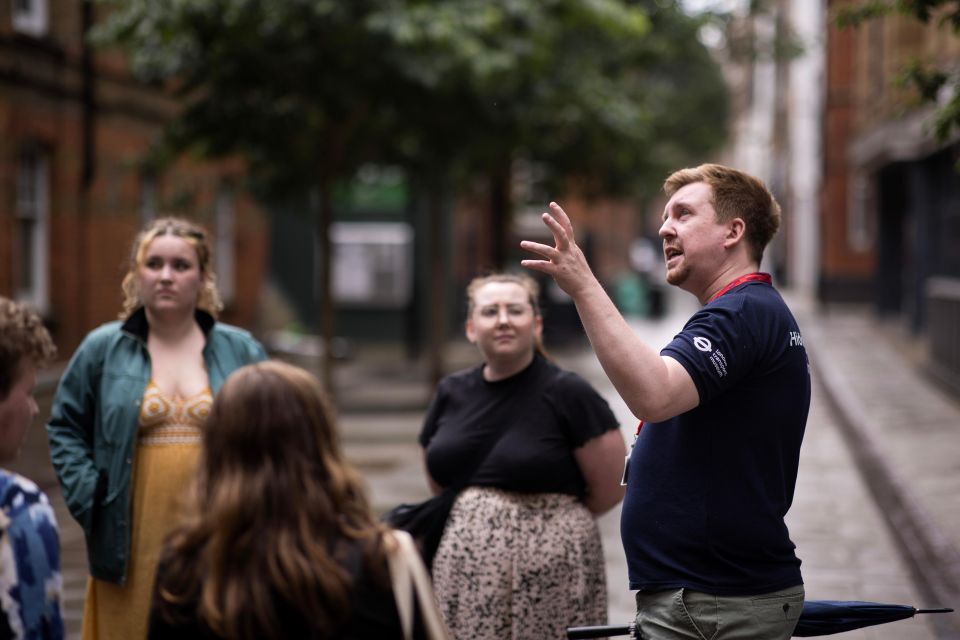
The tour’s Central London story begins in an area people often associate with entertainment and shopping. But you’ll hear it as a transport corridor shaped by foot traffic, street evolution, and civic change.
You’ll learn about how Covent Garden was originally known as Convent Garden. That may sound like a small historical detail, but it’s the kind of clue that makes you see the area differently. Names don’t change at random; they track how a place becomes understood—economically, socially, and eventually, in how movement through the area gets organized.
You’ll also hear about the first theatres that opened in the area. Again, this isn’t presented as a list of dates. The angle you’ll get is why theatres matter for movement: they create predictable crowds, which pressures streets and connections to work efficiently.
And the tour includes a stop where you’ll see the oldest shop in the city. That’s not just a bragging right. It’s a reminder that long-running businesses rely on access. Transport systems—public routes, pedestrian flows, and street design—support places that stay relevant for generations.
If you love walking tours where you can actually point to what the guide is describing, this part hits the mark. You’re in an area where you can look up, look around, and connect stories to what you see.
Kingsway’s Tram Tunnel and Piccadilly Line Construction: Engineering You Can Spot
This is where the tour gets especially good for people who like practical city mechanics. Kingsway isn’t just another street name. You’ll hear how well-known streets shaped London’s transport systems, including the construction stories tied to the Piccadilly line and the Kingsway Tram Tunnel.
You don’t need a technical background to follow it. The guide’s job is to make the engineering understandable in human terms: why certain routes were chosen, what problems engineers were solving, and how the city’s growth influenced the next transport step.
The Kingsway Tram Tunnel story is also a nice reminder that London’s transit history wasn’t always the simplified tube narrative. Before modern underground lines dominate people’s mental picture, there were other methods—tunnels and street-level systems—that had their own constraints and solutions.
And the Piccadilly line gets treated as part of a bigger storyline rather than isolated bragging facts. You’ll start to see it as a product of planning, not luck—built into the street logic that you’re physically walking through.
If you’re the type who normally walks past street features without noticing, this section may make you start looking at streets like they’re diagrams.
Holborn Tunnels: When the Underground Feels Close
One of the most distinctive promises of this walk is the Holborn-area focus on tunnels underground. You’ll hear about the multitude of tunnels in that area—exactly the kind of fact that makes you feel the city’s layers more than you usually do.
Now, here’s the practical part: the tour does not visit disused tube stations or underground spaces. So you’re not touring caves. Instead, you’re learning what exists and why it exists, while you stay on the surface and connect clues to what you’re hearing.
That approach is a win for most people. It keeps the tour moving, keeps the pace manageable (for a two-hour walk), and it avoids the “where’s the entrance?” frustration that some underground-focused experiences create. It also fits the tour’s core style: archive facts tied to the street you’re standing on.
For you, this part is likely to feel like London’s hidden layers have personality. You may find yourself listening differently afterward—paying attention to how streets funnel movement and how the city supports layers above and below you.





Thames First, Trains Second: The River as London’s Early Transport Highway

Transport history starts before railways, before tubes, and before cars. On this tour, you’ll hear about the Thames as the first public transport thoroughfare of London. That’s a big claim, but it’s easy to understand why it makes sense: the river was already a movement corridor, and early London naturally organized around it.
What I like about this segment is the perspective shift. People often treat London’s story as “starting” with buildings and then adding transport later. But with the Thames framed as early infrastructure, you see that movement comes first—and development follows.
You’ll also connect this river importance to why certain areas feel “linked” to the city’s broader travel pattern. Even if you don’t memorize every historical detail, you’ll end the walk with a clearer idea of why the Embankment exists as more than a scenic riverside strip.
This is the kind of context that improves your whole London trip. Later, when you pass the river or plan a route across the city, you’ll understand the logic behind it.
Embankment Gardens and the Sound of Trains: Why Quiet Places Aren’t Silent
A memorable highlight is the tour’s explanation for something many people notice without knowing why: you hear trains running when you’re walking in the tranquil Embankment Gardens.
That’s exactly the kind of everyday observation that becomes more interesting when a guide explains the underlying setup. The point isn’t just to name where trains run. It’s to show how London’s transport infrastructure sits close to places people experience as calm—so “quiet” is sometimes more about your perspective than about true distance.
This part is especially helpful if you’re the kind of traveler who enjoys learning how cities work at street level. You’ll start to treat “sounds” and “sensations” as part of the transport story, not random background noise.
If you plan to return to the Embankment later, you’ll get a bonus: you’ll likely recognize and understand what you’re hearing, which makes a familiar walk feel fresh.
Price and Value: Is $26 Worth Two Hours of London Facts?
At about $26 per person for roughly two hours, this tour sits in the “good value for time” category—assuming you like walking and you want more than postcard sightseeing. The reason it’s good value is simple: you’re paying for guided interpretation of multiple Central London areas, plus the kind of archive-based stories that usually only show up if you go hunting in books or museums.
Also, you’re not paying for museum admission. The London Transport Museum is nearby and relevant, but entry isn’t included. That’s a smart model if you like staying focused on the walking story and then deciding later if you want to add museum time.
Where value might depend on you: if you prefer tours that slow down, translate every detail, and guarantee a relaxed pace, this might feel a bit more “city-fast.” The tour involves busy crossings and uneven ground, and you’re walking the whole time. For some people, that’s part of the fun. For others, it reduces how much they catch.
Logistics That Actually Matter (Not Boring, Just Real)
Here’s what to plan for so the tour stays enjoyable:
- Wear sturdy footwear. Uneven ground is part of the reality, not a warning you can ignore.
- Expect road crossings and busy sidewalks. If you get flustered in traffic zones, give yourself buffer time to stay calm.
- Bring a passport or ID card. Yes, it’s an extra step, but it’s listed as required.
- Don’t bring luggage or large bags. If you’re touring with a big day bag, keep it small enough to feel comfortable.
- There’s no cloakroom. If you need a place to stash something, you’ll have to plan that on your own before you meet.
If you’re sensitive to audio speed, it’s worth knowing the tour is in English and is delivered while walking. If English isn’t your strongest language, consider this carefully before you book.
Who This Walk Fits Best
This tour is a great fit if you:
- Like transport history presented through streets and stories you can see
- Enjoy practical, real-world explanations instead of only big-name landmarks
- Want a quick overview that helps you understand London’s movement patterns for the rest of your trip
It’s less ideal if you:
- Need a slower pace with lots of time to stop and regroup
- Struggle to follow English while moving through busy areas
- Rely on mobility support beyond what a walking tour can provide. Even though it’s listed as wheelchair accessible, the tour involves uneven ground and road crossings, and it’s also marked as not suitable for people with mobility impairments.
It’s also not suitable for children under 9. If you’re traveling as a family, think hard about whether your child will enjoy listening while walking for up to two hours.
Should You Book This Walking Tour?
If you want to see Central London with better “how it works” eyes, I think this is worth booking. For $26 you’re getting two hours of transport history connecting the Thames, theatre-area development, and major infrastructure threads like tram tunnels, the Piccadilly line, and Crossrail-era changes.
I’d book it especially if you enjoy the feeling of learning something that changes how you look at the city later. The best part is that you don’t need special tickets for underground spaces—you’re guided through the surface with explanations that make the invisible layers feel real.
Skip it only if you know you’ll have trouble following English at a walking pace, or if the idea of busy crossings and uneven ground is stressful rather than exciting.
If you’re on board with walking and you like transport stories, this tour is one of the smarter ways to spend a couple hours in London’s center.
FAQ
Where does the tour meet?
The tour meets outside the main entrance of London Transport Museum, Covent Garden Piazza, WC2E 7BB. The Hidden London team member meets you 15 minutes before the start time.
How long is the tour?
The tour lasts about 2 hours.
How much does it cost?
It costs $26 per person.
Is museum entry included?
No. Entry to London Transport Museum is not included.
Does the tour visit disused tube stations or underground spaces?
No. This tour does not visit any disused tube stations or spaces.
What language is the tour in?
The live guide speaks English.
What should I bring?
Bring a passport or ID card.
Is it suitable for children?
It is not suitable for children under 9.
Is there a place to store luggage?
No. Luggage or large bags are not allowed, and there is no cloakroom.